ChinaKnowledge.de -
An Encyclopaedia on Chinese History and Literature
Manzhou shilu 滿洲實錄 (Manchu name Manju-i yargiyan kooli, Mongolian name Manzhiĭn u̇nėn magad khuulʹ) "Veritable records of the Manchus" is a kind of official history of the Manchu state under the rule of Nurhaci (Emperor Taizu 清太祖, r. 1616-1626). The 8-juan long book was compiled following an edict by emperor Huang Taiji (Emperor Taizong 清太宗, r. 1626-1643), to record the history of his father's establishing the Manchu rule in the northeast.
Some material of it, especially the maps illustrating the conquest of China, later found its way into the history Wu Huangdi shilu 武皇帝實錄 "Veritable records of the Martial Emperor [i.e. Nurhaci]". The original text went lost, so that the new version of the Manzhou shilu, compiled under the Qianlong Emperor 乾隆帝 (r. 1735-1796), was compiled with the help of material from the Wu Huangdi shilu.
While the illustrations of these two chronicles are largely the same, the textual differences to the later official history of the early Manchus, Taizu shilu 太祖實錄 "Veritable records of Emperor Taizu", are very great. The latter is the beginning part of the series Da-Qing lichao shilu 大清歷朝實錄 "Veritable records of all rulers of the Great Qing dynasty", shortly called Qingshilu 清實錄.
| ... Golmin Šanggiyan Alin-i šun dekdere ergi Bukūri gebungge alin, Bulhūri gebungge omoci tucike. Tere Bukūri alin-i dade bisire Bulhūri omo de abkai sargan jui Enggulen, Jenggulen, Fekulen ilan nofi ebišeme jifi, muke ci tucifi etuku etuki sere de, fiyanggū sargan jui etukui dele enduri saksaha-i sindaha fulgiyan tubihe be bahafi, na de sindaci hairame angga de ašufi etuku eture de, ašuka tubihe bilha de šuwe dosifi, gaitai andande beye de ofi, wesihun geneci ojorakū hendume, mini beye kušun ohobi, adarame tutara sehe manggi, juwe eyun hendume, muse lingdan okto jekebihe, bucere kooli akū, sinde fulingga bifi kušun ohobidere, beye weihuken oho manggi jio seme hendufi genehe. Fekulen tereci uthai haha jui banjiha. |
| 滿洲原起於長白山之東北布庫哩山下一泊。名布勒瑚里。初天降三仙女。浴於泊。長名恩古倫。次名正古倫。三名佛庫倫。浴畢上岸。有神鵲。銜一朱果。置佛庫倫衣上。色甚鮮妍。佛庫倫愛之。不忍釋手。遂銜口中。甫著衣。其果入腹中。即感而成孕。告二姊曰。吾覺腹重。不能同昇奈何。二姊曰。吾等曾服丹藥。諒無死理。此乃天意。俟爾身輕上昇未晚。遂別去。佛庫倫後生一男。 |
| The cradle of the Manchu people lies northeast of Mt. Changbai (Golmin Šanggiyan Alin), to the foots of Mt. Bukūri, at a lake called Bulhūri. In the beginning Heaven sent down three fairy maidens to bathe in the lake. The oldest of them was called Enggulen, she second one Jenggulen, and the youngest Fekulen. Having finished their bath, they went back to the shore. There was magpie, bearing a red fruit in its mouth, which it had laid on the clothes of Fekulen. It was very fresh and colourful. Fekulen was pleased by it, but did not dare to tough it, and therefore took it between her teeth. Yet when she dressed herself, she swallowed the fruit, and immediately had the feeling of being heavily pregnant, and thus unable to return to Heaven. The second sister said to her: "We ate the red pill of immortality and cannot wait for you here. This is the will of Heaven." So they left [Fekulen] back. Fekulen thereafter gave birth to a son [the progenitor of the Aision Gioro clan]. |
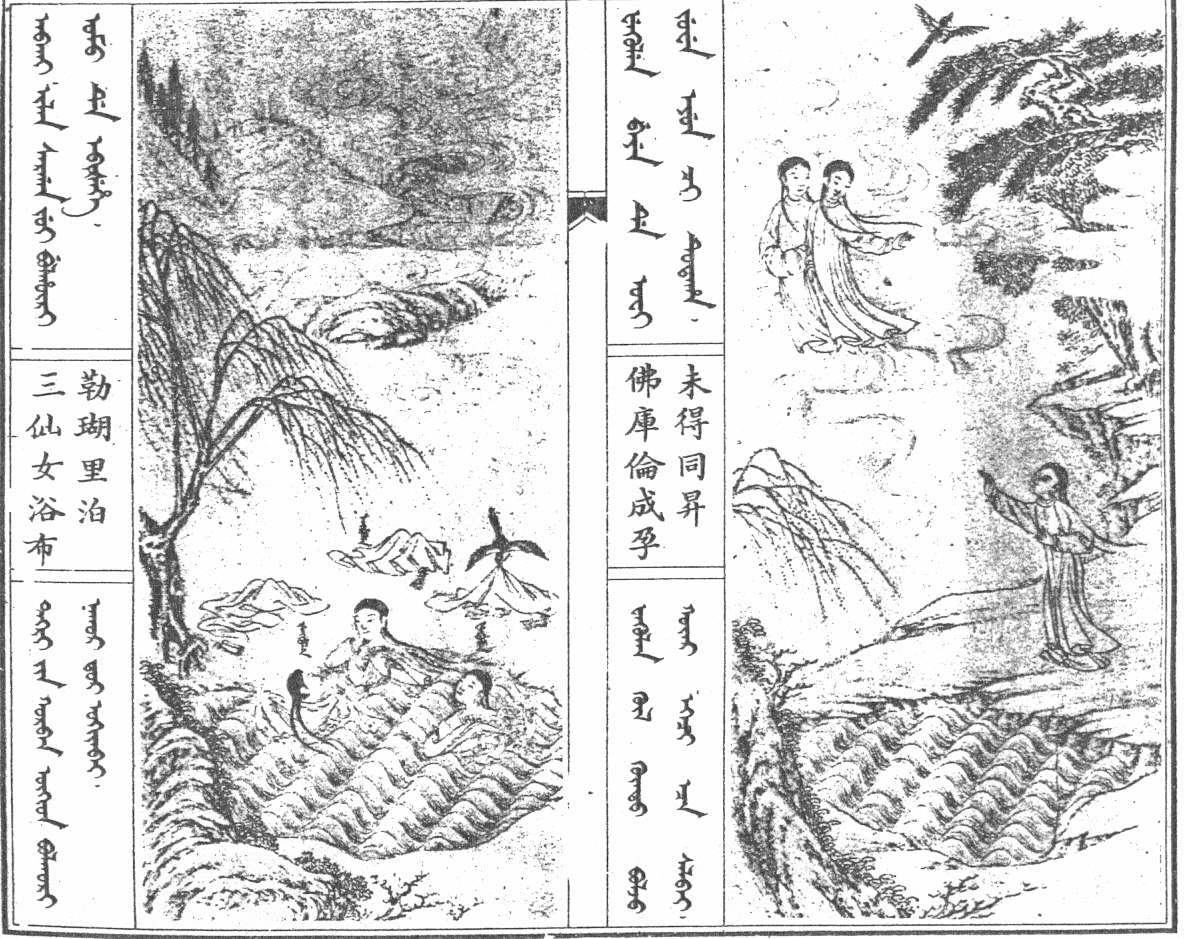 |
Images from the tilingual edition of the Manju yargiyan kooli in the (Chinese) Da-Qing lichao shilu 大清歷朝實錄. Left: The three sister fairies take a bath in Lake Bulhūri. Meanwhile, a Heaven-sent magpie lays down a red fruit on the clothes of Fekulen. Right: Being impregnated by the red fruit, Fekulen is too heavy to accompany her sisters back to Heaven. Later on, when her son was older, she eventually left him and reunited with her sisters. Part of the Manchu text is tongki fuka akū hergen, i.e. without diacritical dots. |