ChinaKnowledge.de -
An Encyclopaedia on Chinese History and Literature
Juan 卷 "scroll" or "fascicle" is a counting unit used in traditional Chinese books. It is often congruent to one chapter, but may also contain several chapters. Very long chapters can also stretch over several "scrolls".
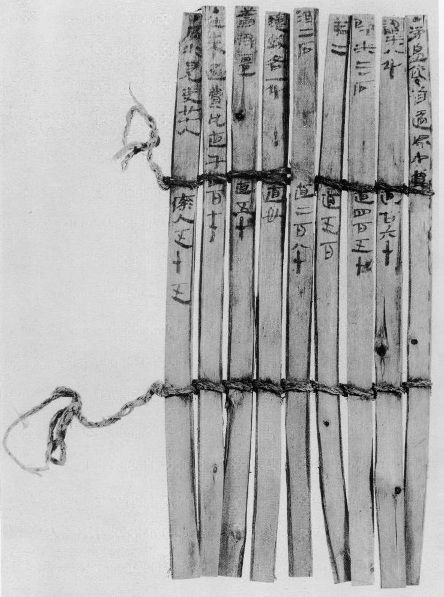 |
Fragment of an accountancy scroll from the Han period found in Juyan 居延, Gansu). Zhonguo meishu quanji bianji weiyuanhui 1987: 79, no. 54. |
In antiquity, the writing material for all kinds of records, from books to tax registers, was bamboo slips (jian 簡) that were inscribed vertically from right to left with one column per slip, and tied together with two or three threads. The length of such writing "boards" was less than one metre. They were rolled up and stored on shelves in the libraries and archives. Whole books thus consisted of several scrolls that had to be marked on the outside, indicating which chapters each particular scroll contained. The name of the book and of the chapter was often also written down inside, on the first slip.
With the invention of paper during the Han period 漢 (206 BCE-220 CE), a much lighter and more comfortable, yet more perishable, writing material became available. Bamboo slips were not entirely abandoned, and therefore, the counting unit "scroll" continued to play a role. It was even used when bamboo was no longer used as a writing material because the successor material, paper, was tied together in different ways to form small booklets that were approximately the same size as each other, just like the bamboo scrolls before. Such a booklet contained several scrolls. The roughly fixed size of scrolls was a good measure to indicate the size of a book (the more accurate measure is to give the number of characters). Furthermore, scrolls were numbered and thus served as a chapter numbering. Today, the word juan is therefore often translated as "chapter", which is not always quite correct.