|
|
 |
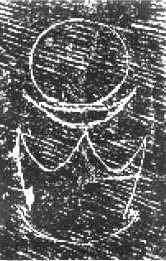
Chinese characters (hanzi 漢字) are symbols of a logographic script developed for the Chinese language. The oldest traces of Chinese characters are to be found in oracle bone inscriptions from the late Shang period 商 (17th-11th cent. BCE), but precursors of characters have been detected on objects of the Erligang culture 二里岡.
Chinese characters represent syllables, and because ancient Chinese was a highly monosyllabic language, in most cases also words. Chinese characters are no pictures (pictograms), as often said, but symbols for words. The Chinese script is a logographic script, each character representing a word. While part of the Chinese characters is ideographic (representing an idea or a concept), 80 per cent of characters include a phonetic part. The composition of Chinese characters follows strict rules and is very logical. There is a limited amount of components that can be used to create new characters. The script is thus highly standardized and much easier to learn than commonly believed. With a basic treasure of characters, all others can instanly be analyzed.
ba "three" (signific 三 "three", phonetic 巴) |
chữ "character" (signific 字 "character", phonetic 宁) |
lớn "great" (signific 大 "great", phonetic 吝) |
| Three examples of Vietnamese chữ nôm characters |
Unlike alphabetic scripts, the logographic character of the Chinese script makes it nearly impossible to use it for other languages. Koreans and Japanese, whose languages are agglutinating, used Chinese characters to write in Chinese (the hanmun resp. kanbun 漢文 texts), but as soon as they started writing in their own language, appropriate alphabets had to be developed. The same is true for the Khitans, Jurchens and Tanguts that had adopted the Chinese script as a model for their own script. The only exception is the use of the Chinese script for Vietnamese, a likewise isolating and highly monosyllabic language. Yet as a language with a different grammar (for example, adjunct after the core noun instead of before it, like in Chinese) and a different lexicon, even Vietnamese scholars invented new characters (chữ nôm) to write in Vietnamese language. Exactly this procedure shows that the largest part of the Chinese characters is perceived as representing a certain sound, and not only a semantic "idea". Even for Chinese topolects like Cantonese or Taiwanese, new characters were invented to represent a lot of particles phonetically different from standard Chinese, like 佮 kah, kap "and" in Taiwanese, or the possessive particle ge 嘅 in Cantonese.
It is not correct to say that one character has one pronunciation or exactly one sound. There are lots of characters with different pronuncations that also indicate different meanings. The largest part of polyphonic characters (duoyinzi 多音字) only change the tone pitch, but there are also a lot of characters having several very different pronunciations, like
- 行 xíng and háng, like xíngzǒu 行走 "to walk", lǚxíng 旅行 "to travel", yínháng 銀行 "bank", hángyè 行業 "trade, industry",
- 說 shuō, yuè and shuì, like shuōhuà 説話 "to speak, to gossip", shuōfa 説法 "wording, formulation", tīngshuō 聽説 "to be told, to hear of", yuè 說 "happy" (same as 悅), yóushuì 遊説 "to go arround drumming up support, to lobby",
- 賈 gǔ and Jiǎ, like shānggǔ 商賈 "merchant", gǔhuò 賈禍 "to invite misfortune", Jiǎ 賈 (a surname).
- 散 sǎn and sàn, like sànbù 步 "to take a walk", sànkāi 散開 "to disperse", sǎnluàn 散亂 "in chaos, disorganised", sǎngōng 散工 "part-time job, seasonal labourer",
- 樂 yuè and lè, like yīnyuè 音樂 "music", yuèqì 樂器 "musical instrument", kuàilè 快樂 "happy", lèqù 樂趣 "delight, pleasure",
- 重 zhòng and chóng, like zhòngyào 重要 "important", qīngzhòng 輕重 "weight", chóngxīn 重新 "again, start afresh", Chóngqìng 重慶 (the city of Chongqing, Chungking).
This is not a phenomenon of modern Chinese but can be observed, for instance, in ancient commentaries to Han period 漢 (206 BCE-220 CE) texts, for instance, Ao, yin wu lao fan 媼,音烏老反 "媼 is pronounced NG-AO" (commentary of Wen Ying 文穎 in Hanshu 漢書 1, for this traditional method of indicating sound, see the fanqie system 反切). In lexica, the more-often used pronunciation is dealt with first. The character 說 is virtually always read shuō in modern Chinese, while the pronunciations yuè and shuì are used very rarely, shuì the least often, and therefore standing in the third position, and not alphabetically in the first position. If separated phonetically, the respective words appear in two places in a dictionary, if not separated phonetically (like in a dictionary whose entries are arranged graphically), the respective words have to be marked as to which pronunciation is correct.
While most characters or written words are quite unambigous even if standing alone and not bound into a context, this is not the case for spoken words. The phonetic treasure of Mandarin Chinese is relatively small compared to other languages, and many words therefore can have severeal meanings if not written or if the context is missing. These words are called homophones (tongyinci 同音詞), like
- chéngshì 程式 "pattern, formula" and 城市 "town, city",
- xíngshì 刑事 "criminal, penal" and 形勢 "terrain; circumstances",
- huìhuà 繪畫 "painting" and 會話 "conversation",
- núlì 努力 "to make efforts" (actually nǔlì) and 奴隸 "slave",
- zhùmíng 著名 "famous" and 注明 "to label, to give indication",
- zhèngwù 證物 "to exhibit a legal evidence" and 正誤 "to correct mistakes", and many more.
Even terms of the same word group can easily be confounded, like
- sànbù 散步 "to take a walk" and 散佈 "to spread, to disseminate"
- huìyì 會議 "conference" and 會意 "understanding, knowing"
- shíyóu 石油 "petrol" and 食油 "cooking oil", or
- shāngrén 商人 "merchant" and 傷人 "to injure sb."
Yet the semantic context is so helpful that each word is certainly understood in spoken language. The argument that abolishing the Chinese script would lead to chaos in conversation is simply not valid. Otherwise Chinese people would not be able to talk to each other. Yet a higher level of language use makes it necessary to use more complicated words which require certain character (semantic) combinations and certain specialized characters that do not belong to the everyday "character treasure". Chinese academicians often write down the terms they are using or describe the characters of the word they make use of. Even the characters of personal names are often described or written with the finger on the palm of a hand to make clear which character is meant. For this reason, a specialized vocabulary was developed for the description of characters. Radicals and graphic elements are given terms to make description easier, like caozi tou 草字頭, sandian shui 三點水 or tishou pang 提手旁. In daily use characters are often explained in the wrong way. The surname Zhāng 章, for example (homophoneous to the much more common surname Zhāng 張), is described as lì zǎo Zhāng 立早章. The character is thereby wrongly divided into the parts 立 "stand" and 早 "early". The correct etymological analysis would be 音 "music" and 十 "decade", namely 章 "stanza".
One function of dictionaries is to inform the reader which character is the correct one (for example, all following words containing the syllable shì are written with a different character: chengshi 城市, zhanshi 戰士, biaoshi 表示, fangshi 方式, kaoshi 考試, jiaoshi 教室, xingshi 刑事, xingshi 形勢, jieshi 解釋, zhuangshi 裝飾, heshi 合適). There are still many words that can be written with different characters, and even highly educated persons often do not know which character is the correct (goutong 勾通 or 溝通 "to link up, to communicate, communication").
Although the phonetic range of Chinese is not very broad (everythings sounds like "ching, chang, chong") the possible combinations of two characters to a new word are countless, like shichang 市場 "market", shijing 市井 "town", shijia 市價 "market price", shihu 市虎 "tigers on the market – rumours and slanders", shimin 市民 "townspeople", shihui 市惠 "dispense favours in order to win popularity", shinei 市內 "inside the town – local", shiqu 市區 "district, downtown", shizheng 市政 "municipal administration", shengshi 城市 "city", naoshi 鬧市 "busy streets", dushi 都市 "metropolis", menshi 門市 "retail sales", yeshi 夜市 "night market", jishi 集市 "country fair", or heishi 黑市 "black market", all including the word shi 市 "market, to marketize".
Throught he ages, new Chinese characters were invented, so that character dictionaries (zidian 字典) trying to record all ever-used characters reach a number of 100,000. In fact, 90 per cent of these are either outdated or writing variants, so that average dictionaries contain not more than about 10,000 characters. Even of these, two thirds are rarely used. An amount of 3,000 characters suffices to read and understand 99 per cent of all characters modern texts (not words, but characters!), with 2,000 characters, 97 per cent can be understood, and even 1,000 characters are enough to understand 88 per cent. The growing lexicon of characters is reflected in the characters recorded in dictionaries:
| dictionary |
compiler |
year |
characters (main + alternative) |
| 倉頡篇 Cangjiepian |
|
|
3,300 |
| 訓纂篇 Xunzuanpian |
揚雄 Yang Xiong |
1-5 CE |
5,340 + 2,040 |
| 續訓篇 Xuxunpian |
班固 Ban Gu |
60-70 CE |
6,180 + 840 |
| 說文解字 Shuowen jiezi |
許慎 Xu Shen |
100 CE |
9,350 + 3,173 |
| 聲類 Shenglei |
(魏)李登 Li Deng |
227-239 |
11,520 + 2,167 |
| 字林 Zilin |
(晉)呂忱 Lü Chen |
4th cent. |
12,824 + 1,304 |
| 字統 Zitong |
(後魏)楊承慶 Yang Chengqing |
? |
13,734 + 910 |
| 廣雅 Guangya |
(魏)張揖 Zhang Ji |
3rd cent. |
18,150 + 4,416 |
| 玉篇 Yupian |
顧野王 Gu Yewang |
543 |
22,726 + 4,576 |
| 唐韻 Tangyun |
孫愐 Sun Mian |
751 |
26,194 + 3,468 |
| 韻海鏡源 Yunha jingyuan |
顏真卿 Yan Zhenqing |
753 |
26,911 + 717 |
| 類篇 Leipian |
王洙 Wang Zhu, 胡宿 Hu Su, 司馬光 Sima Guang |
1066 |
31,319 + 4,408 |
| 字彙 Zihui |
梅膺祚 Mei Yingzuo |
1615 |
33,179 + 1,860 |
| 正字通 Zhengzitong |
張自烈 Zhang Zilie |
1675 |
33,440 + 261 |
| 康熙字典 Kangxi zidian |
陳廷敬 Chen Tingjing et al. |
1716 |
42,174 + 8,734 |
| 中華大字典 Zhonghua da zidian |
歐陽溥存 Ouyang Pucun, 徐元誥 Xu Yuangao, 汪長祿 Wang Changlu et al. |
1915 |
44,908 + 2,734 |
| 漢語大字典 Hanyu da zidian |
漢語大字典編輯委員會 Hanyu da zidian bianji weiyuanhui |
1986-1990 |
54,678 |
| 中華字海 Zhonghua zihai |
冷玉龍 Leng Yulong, 韋一心 Wei Yixin et al. |
1994 |
85,568 |
| 異體字字典 Yitizi zidian |
李圃 Li Pu et al. |
20042 |
106,230 |
 |
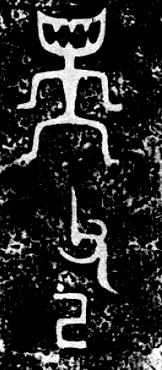
| Inscription of a li 鬲 type bronze vessel with a clan insignium, reading □父已 "Father Yi of the NN [clan]". From XXX , No. 481. |
The invention of Chinese characters is traditionally attributed to Cang Jie 倉頡, a minister of the mythical Yellow Emperor 黃帝. Unfortunately there is no stage known between the age when characters were used to signify clan names or personal names, and the time when the script appeared in a full stage on the oracle bones and bronze vessels of the Shang period. The texts of the oracle bone inscriptions are highly technical and therefore represent only a narrow lexicon. About 2,000 characters are known, but a lot of oracle bone characters have an unknown meaning. Part of the problem is that characters at that time were not yet standardized. The script was still in a state of experiment, althought it is very clear that new characters were systematically developed.
The six types of characters liushu 六書
The term liushu 六書 "six types of characters" is first mentioned in the Confucian Classic Zhouli 周禮, as a general word for "reading and writing". During the Han period children started learning to write at the age of 8 sui. Liu Xin 劉歆, in his treatise Qilüe 七略, enumerates the six types of characters as xiangxing 象形 "illustrating a shape", xiangshi 象事 "illustrating an affair", xiangyi 象意 "illustrating an idea", xiangsheng 象聲 "illustrating a sound", zhuanzhu 轉注 "mutual comment" and jiajie 假借 "wrongly borrowing". The first four are actually not necessarily types of characters but rather elements in characters. The last two are types of character use, the zhuanzhu type as exchangeable characters with similar or equal meaning, the jiajie type loan characters for words with identical pronunciation. In the respective ancient literature, no examples are provided for these types, so that the exact meaning of these types is not really clear.
Zheng Zhong 鄭眾, author of a commentary to the Zhouli 周禮 (Zhouguan jiegu 周官解詁), changed this listing to xiangxing 象形 "illustrating a shape", huiyi 會意 "combined meaning", chushi 處事 "dealing with an affair", xiesheng 諧聲 "harmonized sounds", zhuanzhu 轉注 "mutual comment" and jiajie 假借 "wrongly borrowing". This new list was not a new concept of Liu Xin's older list, but only a renaming.
The most famous concept of the six types of characters has been established by the late Han period scholar Xu Shen 許慎 in the preface to his dictionary Shuowen jiezi 說文解字. He provides the following pattern of character types:
- xiangxing 象形 "illustration of a shape" is an ideograph of objects, like
日 "sun",
月 "moon",
山 "mountain",
水 "water",
木 "tree",
different animals and plants like
馬 "horse",
羊 "sheep",
竹 "bamboo",
米 "grain",
or parts of the body like
手 "hand",
眉 "eyebrow",
气 "breath", or various tools like
戈 "halberd",
鼎 "tripod".
This group also includes symbols of figurative meaning, like
交 "exchange" (a picture of crossed legs),
出 "going out" (originally a foot coming out of a compound),
步 "to go" (two steps),
降 "to go down" (two steps down a hill?),
立 "to stand, to erect" (a man above a horizontal line, as the earth),
至 "to arrive" (an arrow hitting the target),
"to hear" (an ear and a mouth; is probably of the huiyi type),
折 "to cut" (a hand holding an axe; is probably of the huiyi type),
"to obtain" (a hand an a shell, expressing value; the component 彳 "proceed" of 得 has been added later), or
牧 "to shepherd" (a whip and a cow; is probably of the huiyi type).
- zhishi 指事 "pointing at a matter" is the visualization of an idea, like
上 "above" (the plain 一),
下 "below",
本 "root" (of a tree 木),
末 "branch",
刃 "blade" (of a knife 刀),
乏 "deficient" (opposite of the turned character 正 "correct"), or
匕 "change", a turned 人 "man".
Characters of this category are either basic characters altered by an additional stroke, or charactes turned around or mirrored.
- huiyi 會意 "combined meaning" is a combination of two or more characters to a new one, like
- 武 "war" from 戈 "halberd" and 止 "foot",
- 信 "trust" from 人 "man" and 言 "spech" (Xu Shen's analysis of 信 [ɕin] xin is wrong. Later scholars have found out that it is actually a combination of 言 "to say" and the phonetic 千 [tɕʰiɛn] qian.),
- 喪 "funeral" from 哭 "weeping" and 亡 "gone, dead",
- 旦 "dawn" from 日 "sun" and the horizon,
- 公 "public" from 八 "to separate" and ㄙ "private", or
- 好 "good" from 女 "wife" and 子 "child".
- xingsheng 形聲 "shape and sound" is a combination of a signifying part and a phonetic part, like
- 江 [keoŋ] "river, Yangtse" from the signific 氵 (水) "water" and the phonetic 工 [koŋ], or
- 河 [ɣa] from the signific "water" and the phonetic 可 [k'a].
This is an advanced type of character that came up relatively late in the history of the invention of characters. It is, nevertheless, that type of character that is used most. 80 or even 90 per cent of characters belong to the xingsheng type. Some characters newly created according to this pattern were even to replace older, more pictographic types, like
- 鳳 [bĭωəm] "phoenix" (from 鳥 "bird" and 凡 [bĭωəm]), or
In the follwing list of oracle bone characters it can be seen that the fifth character already bears the phonetic 凡 (for its shape, see above No. 8), before it became a regular part of the character (from No. 10). The characters are arranged chronologically. No. 17 is the standard seal script character for "phoenix".

- 雞 [kie] "hen" (from 隹 "small bird" and 奚 [ɣie]).
In the follwing list of oracle bone characters it can be seen that the second character already bears the phonetic 奚. No. 10 is the standard seal script character for "hen, cock".

The change of phonetics in the last 2,000 years has reduced the feeling of users that characters have indeed a phonetic aspect. The modern reading of characters does often not have the slightest homophony with the phonetic parts once used to express the sounding. Even in Archaic Chinese the phonetics have not exactly the same pronunciation, but only a quite similar one. The creators of new characters did furthermore not necessarily use homophones (word of equal sounding) for the phonetic part of the new character, but often only "homoiophones" (words sounding similar). The phonetic part of characters was therefore already during the Han period only an approximate indication of the pronunciations, and by no means a scientific transcription. Some outstanding examples of non-similarity or very distant similarity of sound are (both modern and archaic reading are provided):
- di 滌 (old [dĭəuk], putative phonetic tiao 條 [diəu]),
- sa 灑 (old [ʃĭə], putative phonetic li 麗 [lĭə]),
- reng 仍 (old [ɳĭəŋ], putative phonetic nai 乃 [nə]),
- te 特 (old [dək], putative phonetic si 寺 [zĭə]),
- diao 雕 (old [tiəu], putative phonetic zhou 周 [ţiəu]), or
- ning 凝 (old [ŋĭəŋ], putative phonetic yi 疑 [ŋĭə])
In characters of the xingsheng type, both signific and phonetic can be abbreviated, like:
- 喬 from 夭 and abbreviated 高,
- 耊 from abbreviated 老 and 至,
- 弒 from abbreviated 殺 and 式,
- 軍 from 車 and abbreviated 包,
- 爯 from 爪 and abbreviated 冓,
- 頫 from abbreviated 逃, and 頁,
- 弗 from abbreviated 韋 (all with abridged significs or radicals, shengxing 省形), or
- 融 from 鬲 and abbreviated 蟲,
- 產 from 生 and abbreviated 彥,
- 夜 from 夕 and abbreviated 亦,
- 炭 from 火 and abbreviated 岸,
- 炊 from 火 and abbreviated 吹,
- 奔 from 夭 and abbreviated 賁,
- 疫 from 疒 and abbreviated 役,
- 麇 from 鹿 and abbreviated 囷, or
- 琁 from 玉 and abbreviated 旋 (all with abridged phonetic, shengsheng 省聲).
There are also different possibilities to render a certain sound with the help of different phonetics, or the meaning by different significs. More information can be found below, in the paragraph about vulgar variants of characters.
- zhuanzhu 轉注 are characters of similar meaning and similar pronunciation, like
- kao 考 "old" and lao 老 "aged", or
- biao 標 "tip of a branch" and miao 杪 "end of a stalk".
Some scholars explain this type as a kind of tautology like
- "葍 is
{艹/富}" and " {艹/富} is 葍", or
- "蓨 is 苗" and "苗 is 蓨".
An even narrower definition is that both characters are to have the same radical or signific part.
- jiajie 假借 "wrong borrowing" are characters that are borrowed for a word of the same pronunciation and for which no character exists. Xu Shen gives the examples
- ling 令 "order" from ming 令 "command" (later written 命; perhaps a zhuanzhu type character?) and
- zhang 長 "headperson", from chang 長 "long hair".
Yet modern scholars say that these two examples are only extensions of the original meaning, and not loan characters. Better examples are
- 我 "me" (actually a weapon, similar to 武),
- 汝 "you" (actually the name of a river),
- 其 "his, her, this" (original meaning "basket"), or
- 來 "to come" (actually grain, like 麥).
Loan characters also occur if the writer forgot or did not know the proper character. Some original characters (benzi 本字) have later often become obsolete (like 垔). In ancient writings a character often stood for very different things, like 齊 for 齋, 劑, 臍, 躋, 韲 and 薺. The last few characters have only been created during the Han period or even later, they are new inventions (houqizi 後起字).
- 率 "command" was originally a net for catching birds.
- 不 "not" was a flower calyx, yet Xu Shen interpretes it as "a bird not coming down".
- 猶 "seemingly, yet" was originally a kind of monkey.
Similar examples can be shown in almost all grammatical particles or pronouns, like
- 乃 "breast" for "therefore",
- 其 "basket" for "his, her, this",
- 之 "to go" for a genetive particle and object pronoun, or
- ye 也 "uterus" for an equalizing particle.
If a character was borrowed for another meaning, it was common that a new character was created for the original meaning of the word, like
- 乃 "breast", used for "therefore", new character for "breast, milk": 奶,
- 且 "ancestral altar", used for "and, being about to", new character for ancestor: 祖,
- 其 "basket", used for "his, her, this", new character for basket: 箕,
- 莫 "morning" used for "nobody, not", new character for "morning": 暮,
- 暴 "warm", used for "cruel", new character for "warm": 曝,
- 須 "beard" used for "must", new character for "beard": 鬚,
- 韋 "encircle" used for "to change", new character for "encircle": 圍,
- 然 "fuel" used for "being like, to be so", new character for "fuel": 燃,
- 監 "mirror" used for "supervise", new character for "mirror": 鑑,
- 益 "to flow out, to brim over" used for "to increase", new character for "flow out": 溢,
- 原 "source, well" used for "original, beginning", new character for "well": 源.
The most important premodern studies on the six types of characters are the treatise Liushu lüe 六書略 which is part of Zheng Qiao's 鄭樵 history Tongzhi 通志 from the Song period 宋 (960-1279), and the Liushugu 六書故 by the Yuan period 元 (1279-1368) scholar Dai Tong 戴侗.
Except these writing styles, there are also lots of ornamental and magical scripts, like the "jade chopstick script" (yujin zhuan 玉筋篆), the "lucky mushroom script" (zhiying zhuan 芝英篆), the "bell and tripod seal script" (zhongding zhuan 鍾鼎篆), the "dropping dew seal script" (chuilu zhuan 垂露篆), and so on. See an example of hundred different ornamental script styles of the character shou 壽 "longevity".
Simplification and standardization
With a new writing surface, the bronze inscriptions of the Zhou period 周 (11th cent.-221 BCE)
with their long texts simplified the ideographs, reduced strokes and standardized the characters. From the mid-Zhou period on, bamboo slips became a widespread writing material. The characters differed from region to region. Most conservative was the script in the state of Qin 秦, which is accordingly called the large (or complicated) seal script (dazhuan 大篆 or zhouwen 籀文), in contrast to the small seal script of the other states (xiaozhuan 小篆). The state of Chu 楚 in the south had a special ductus of the script known from silk inscriptions. With the unification of the empire in 221 BCE, the script was standardized. The imperial government of the Qin adopted the small seal script as the national standard. The standardization led to the common structure of Chinese characters as it is known today. It was prescribed which parts of characters – and in which function – were positioned where. Before that, right and left part of characters had often been ad libitum. Extremely complex characters as seen in some older bronze inscriptions were also given up.
The growing bureucratic nature of the late Warring States period 戰國 (5th cent.-221 BCE) made it necessary to develop a ductus for the Chinese script that could quickly be written. Besides the standardization of characters to make communication faster and easier, a kind of chancery script (lishu 隸書) was developed. This script took over all documents of daily life, while the old complicated script was only used for seals (hence the name "seal script") and inscriptions that were to last for a long time, like weights and measures, inscriptions in stelae, and so on. The chancery script abbreviated complex parts, like 辵 to 辶 "to go" , or 阜 to 阝 "hill, populated place", and the complex characters 晉, 秦, 曹 or 春, and standardized the movement of the writing tool, the brush. In the seal script, curved lines in all directions are very common, but the chancery script only known relatively straight movements of the brush. The chancery script abbreviated the shape of radicals and elements in characters, like the shape of 心 as 忄 if standing to the left, the shape of 火 as 灬 if standing below, the shape of 艸 as 艹 if standing at the top, and so on. Many other characters were thoroughly abbreviated, like 秊 to 年, 奉, 兵, 也, and so on. Yet some complex characters were not abbreviated, like 鳥, 齊, or 龜 and survive until today. The abbreviation of characters helps saving the engergy of the wrist when writing long texts. An easy-to-write script contributed to the distribution of texts, not only of official documents, but also of philosophical writings and private letters. With the growing lexicon to write, a huge amount of characters had to be invented before and during the early imperial period. The early chancery script was modeled to the standard model script (kaishu 楷書) during the Han period 漢 (206 BCE-220 CE). The Later Han period 後漢 (25-220 CE)
was the time when scholars started investigating the origin of Chinese characters, and the first dictionaries were written, of which the Shuowen jiezi 說文解字 is the most famous. Chinese scholars speak of early experiments with the script in the field of arts, resulting in the long and famous tradition of calligraphy (shufa 書法 the "art of writing"). For an even faster writing, the writing styles xingshu 行書 "running script" and caoshu 草書 "grass script" were invented. The Jin period 晉 (265-420) can be seen as the age when the Chinese script matured in all its aspects.
Appearance and components of characters
Unlike other logographic scripts like Egyptian hieroglyphs or cuneiform scripts, the Chinese script consists of characters that all have the same size. This has to do with the fact that one character stands for one syllable and one word. Chinese texts can be thought of as written in a grid of square fields (fangkuai 方塊) that have to be filled to all edges. A simple character like 人 occupies the same space as a complicate one like 囊. Components of characters are accordingly reduced in size:
In prints of minor quality, complex characters are therefore often not readable. Simple characters (wen 文, modern term dutizi 獨體字) are quite rare, at least seen from the whole thesaurus of characters, while compound characters (zi 字, modern term hetizi 合體字) make out 90 per cent of all characters. Most of the latter consist of two parts, either left and right or top and bottom. One of the two parts is mostly a phonetic part (sheng 聲, the phonetic, modern term shengfu 聲符), indicating roughly the pronunciation, and the other part indicates the field of meaning (xing 形, the signific, modern term yifu 意符). This type of character, to which most characters belong, is called xingsheng zi 形聲字.
The position of significs is relatively fixed, for example, 亻彳口氵火木扌犭礻足 are mostly standing to the left, 刀卩阝攴見頁戈鳥 to the right, and 宀穴艹竹雨 to the top of phonetics. This has become a standard with the creation of the chancery script, just like the sequence of the brush strokes, that always go from left to right, from top to bottom, and from outside to inside (except the closing brush stroke).
The signific part of a character is called its radical (bushou 部首). The term bushou came up during the Later Han dynasty. The oldest surviving character dictionary, the Shuowen jiezi, classifies all Chinese characters it records into 540 radicals. Only during the Ming period 明 (1368-1644) the number of radicals was reduced and was fixed at 214. This number is traditionally connected with the Kangxi zidian 康熙字典 dicationary (as the so-called Kangxi radicals 康熙部首), altough it was first used in the dictionary Zihui 字彙 in the late Ming period. Character simplification in the People's Republic and attempts by various scholars to make character lookup easier has resulted in different systems of radicals. Characters that do not follow the principle of combining a phonetic with a signific element, like the huiyi or zhishi characters, are arbitrarily subsumed under one radical, for example 好 "good, to like" under 女 "wife", not 子 "child"; 去 "to erase, to do away" under 厶 and not under 土, and 不 "not" under 一, not under 木. In the last two cases, the radicals are purely graphical and have nothing to do with the meaning of the characters. Many dictionaries have a special index for characters whose radicals are not easy to pick out (nanchazi 難查字).
What has also changed significantly is the monosyllabic character of the language. Most nouns and verbs in modern Chinese are disyllabic, and it is therefore not any longer justified to say that one character represents one word. One has therefore to discern between character dictionaries (zidian 字典) and word dictionaries (cidian 辭典 or 詞典).
An important type of characters not mentioned yet are the "false borrowings" (jiajie zi> 假借字). These characters are mainly "borrowed" to write grammatical particles. The actual meaning is thereby neglected, and only the sound of the character is used. The character 之 "to go to" is borrowed for the “genitive particle” zhi, the object pronoun zhi, and is even used as a demonstrative pronoun. In classical Chinese, the character zhi only occasionally used in the original meaning of a verb "to go to". In modern written Chinese is is mainly used as a "genitive" particle. Other examples are nai 乃 "bosom", borrowed for the explanative copula "it is X which functions as..." or the conjunction "only when..., then...”. The original meaning of "bosom" is lost. The character qi 其 for the word "winnowing basket" is used for the personal pronoun "he, his" and as a demonstrative pronoun. For the original word, a new character was created by adding a bamboo on the top, ji 箕. In modern Chinese it mainly is used in the word qita 其他 "others", but also as a genitive particle in written language. The character and word ye 也 is said to have had the meaning of "uterus, cunnus". In classical Chinese it denotes the end of a phrase expressing accentuation, but also a nominalization. In modern Chinese it has the meaning of "too, also". The original meaning was lost at a very early point of time. The contrary of it, the character (with a somewhat phallic appearance, as some scholars think). qie 且 is explained as the abbrevation of zu 祖 "ancestor, ancestral altar". In Classical Chinese it is used for the coordinative conjunction "and, as well as", which is still common in modern written Chinese, and also in spoken language (for example, in the word erqie 而且 "yet also, but"). The word for morning mo 莫 was used for a negation particle. It became so common that a new character was created for morning, namely mu 暮.
The increasing amount of characters is not only due to the creation of new characters. The number of characters only slightly increases between the Han and the Sui period. A large amount of characters are simply alternative writings (yitizi 異體字), popular or vulgar variants (suzi 俗字 or sutizi 俗體字) or non-standard variants (qizi 奇字). For a lot of characters there was never a standard form established, so that for many words, two different characters can be used, either with a different radical or signifying part, like
- 鷄 or 雞 for ji "hen",
- 譎 or 憰 for jue "to cheat; strange",
- 逴 or 趠 for chuo "distant; to surpass",
- 呧 or 詆 for di "to slander",
- 溪, 谿 or 豀 for xi "creek, valley",
- 偪 or 逼 for bi "to force, to press on; narrow",
- 脣 or 唇 for chun "lips",
- 鯁 or 骾 for geng "fishbone; upright",
- 考 or 攷 for kao "to ask, to examine, to study",
- 杯 or 盃 for bei "cup",
- 迹 or 跡 for ji "trace, footprint",
- 敕 or 勅 for chi "to command",
or with a different phonetic part, like
- 枹 or 桴 for fu "drum stick",
- 詾 or 訩 for xiong (sound of rushing water),
- 胑 or 肢 for zhi "limbs",
- 觵 or 觥 for gong (an ancient wine vessel),
- 悑 or 怖 for bu "to be afraid of",
{手+留} or 抽 for chou "to take away, to draw",
- 澂 or 澄 for cheng "limpid, clear",
- 磨 or
{石+靡} for mo "to grind; millstone", or
- 鯾 or 鯿 for bian "bream" (a kind of fish),
{木+尻} or 栲 for kao "evergreen chinquapin"
- 捶 or 搥 for chui ""to beat, to hammer",
- 褲 or 袴 for ku "trousers",
- 韻 or 韵 for yun "rhyme",
- 蹄 or 蹏 for ti "hoove"
- 礙 or 碍 for ai "to impede"
or with a different shape, like
- The sentence particle 也 is written
{医+殳} in some texts.
- 儿 is a variant of 人,
- 无 is a variant of 無, today again used as a simplified character,
- 礼 is a variant of 禮, today again used as a simplified character,
- 雱 as a variant of 旁, with the same phonetic yet other signific elements,
- 凷 is an old glyph of 塊,
- 灋 is probably the original form of 法 as an abbreviated variant,
- 壄 is a variant of 野,
{(今/酉)+欠} is a phonetic-bearing (今) old variant of 飲,
- 煞 is a variant of 殺,
- 吊 is a variant of 弔,
- 庻 is a vulgar variant of 庶,
- 吴 is a vulgar variant of 吳,
- 犁 is a vulgar (but actually logic, with 利 as a phonetic) variant of 犂,
- 箇, 個 and 个 are variants of the same word "individual, personal, each, one",
- 泛, 汎 and 氾 are three characters for the same word
- 荼 and 茶 are actually the same plant yet perceived as two different words,
- 泪 is a variant of 淚, today again used as a simplified character,
- 床 is a variant 牀, today preferred as the standard character in the PRC.
- The demonstrative pronouns 之, 是, 此, 斯, 茲, and 這 are all loan characters for the same word "this, here".
- 戶, 户 and 戸 is actually the same character in three different "fonts".
Some characters were written with a redundant signific or radical that could easily be left out, like
- 從 "to follow" instead of simply 从,
- 派 "to send out" instead of simply
{派-水},
- 淵 "pool, profound" instead of simply
{淵-水},
- 捋 "to rub, to strip, to smooth out" instead of simply 寽,
- 敝 "shabby, worn out" instead of simply
{敝-攴},
- 鬻 "congee" instead of simply 煮, or
- 鼅 "spider" (with signific "frog"!) instead of simply 蜘 (signific "insect, vermin").
Some superfluous characters were only created in order to assimilate characters in words, like
- 橋樑 "bridge" - 梁 means "bridge", 樑 is superfluous,
- 笤箒 "broom" - 帚 means "broom", 箒 is superfluous,
- 海浬 "nautic mile" - instead of a simple 海里, because 里 means "mile", or
- 水菓 "fruits" - 果 is "fruit", the character 菓 is superfluous.
In different contexts, objects were written with another character, leading to discrimination characters (fenbie zi 分別字), of which some have later adopted a different pronunciation:
- 輓 wǎn "drawing vehicle", new character 挽 for "to draw, to pull"
- 版 bǎn "wooden plate", later "printing", new character 板 for "wooden plate"
- 稱 chēng "to tell, to denominate", discriminating character chèng 秤 "to weigh"
- 受 shòu "to receive", distinctive character 授 "to transmit, to give"
- 知 zhī "to know", distinct from zhì 智 "wisdom"
- 槍 qiāng "lance, spear", separated from 鎗 for "metal polearm" or "musket"
There are whole character families (zizu 字族) that are a mixture of a signific-phonetic characters (xingsheng zi) and signific-signific characters (huiyi), like
- 工 功 攻 "to make efforts"
- 空 腔 椌
{禾+空} {土+空} {艹/空} {虫+空} {谷+空}, "hollow"
- 非 扉 排 騑 輩 輫
{舟+非} "arrangement, separation"
- 緋 翡 痱 "reddish"
- 尨 厖 哤 牻 駹 "motley, piebald, multi-coloured"
- 會
{辰/會} 澮 禬 繪 燴 "to come together"
- 喬 驕
{角+喬} 橋 蹻 鐈 嶠 轎 趫 {广/喬} "protruding"
- 句 鉤 枸 跔 痀 翑 "crooked"
- 包 跑 鮑 飽 胞 孢 炮 蚫 苞 泡 袍 刨 皰 庖 袌 雹 "packed"
Some characters have two variants if one element is written in another position, like
- 崑崙 or 崐崘 (name of a mountain),
- 略 or 畧 "short; strategy",
- 期 or 朞 "time" or
- 群 or 羣 "herd, flock".
Apart from these examples, the Chinese lexicon includes a lot of specialized words that are only used in a very narrow field, like geographic names as
- Ba 灞,
- Fei 淝,
- Gan 灨 or the word
- 崁 in Chikan Hall 赤崁樓,
botanical and zoological terms, as
- 鷇 "nestling" or
- 麒麟 "unicorn",
and many other special terms with characters like
- 臲鼿 "jumpy, jittery, worried",
- 衚衕 (for 胡同) "hutong, dwelling quarter in Beijing",
- 鞦韆 (for 秋千) "swing", or
, a talismanic variant for 岩 "cliff" (and the character with the most brush strokes, namely 51).
With the invention of the brush, the modern style of calligraphy developed with up to 16 different stroke patterns and several rules how to write a character and its elemens. Every character can be separated into a certain number of strokes, the simpliest character being a single horizontal stroke 一 "one", one of the most complex characters, written with 48 brush strokes, is 龘, consisting of three dragons 龍. The stroke number is very important looking for a character in a dictionary. Most modern search indices are oriented in first place according to the radical, and then to the number of the residual strokes.
The six basic brush strokes are:
| 一 | horizontal (heng 橫) |
 |
| 丨 | vertical (shu 竪 or zhi 直) |
 |
| 丶 | dot (dian 點) |
 |
 |
| 丿 | slant to the left without hook or slant to the right with hook, with many derivatives (pie 撇) |
 |
 |
| 亅 | hook (gou 勾) |
 |
 |
| 乁 | slant to the right bottom (ne 抐 or na 捺) |
 |
They can be enlarged to eight different strokes, exemplarified in the character yong 永:

Source: Sancai tuhui 三才圖會, Renshi 人事 3 |
dian 點 "dot" or ce 側 |
heng 橫 "horizontal" or le 勒 |
shu 竪 "vertical" or nu 努 |
tiao 挑 "lift-up" or ti 趯 |
zuoshang 左上 "towards upper left" or ce 策 |
zuoxia 左下 "towards lower left" or lüe 掠 |
youshang 右上 "towards upper right" or zhuo 啄 |
youxia 右下 "towards lower right" or zhe 磔 |
Today, there are five different types of strokes, exemplarified in the character zha 札:
 |
一 heng 橫 "horizontal" |
| 丨 zhi 直 "vertical" |
| 丿 pie 撇 "bend to the lower left" |
| 丶 dian 點 "dot" |
| 乙 na 捺 "bend to the lower right" or "hook" |
The basic rules of stroke order are:
| from left to right |
 |
| from top to bottom |
 |
| from inside to outside (if inner brush stroke is longer) |
 |
| from outside to inside, yet closing bottom line at last |
 |
| first horizontals, then verticals |
 |
| in x-crossed parts first the left slant, then the right |
 |
| long horizontal crossing strokes are written last |
 |
| in calligraphy, these rules are often not adhered to |
|

Xu Shen, author of the dictionary Shuowen jiezi, speaks of eight different writing styles (bati 八體) used during the Qin Period: the large seal script (dazhuan 大篆), small seal script (xiaozhuan 小篆), the carving script (kefu 刻符 used for inscriptions on seals and tallies, the insects script (chongshu 蟲書) or birds-and-worms scirpt (niaochongshu 鳥蟲書), the imprint copy script (moyin 摹印) used for inscriptions on the surface of seals showing how the seal imprint will look like), the appointment script (shushu 署書) used for inscriptions as document titles and on boards, the lances script (shushu 殳書) used for inscriptions on weapons, and the chancery script (lishu 隸書). The problem with this categorization is that it is a mixed list of writings styles and of uses of inscriptions. A different concept has, for example been used by the Yuan period 元 (1279-1368) calligrapher Zhao Mengfu 趙孟頫 in his work on the Thousand-characters classic, written in six styles, the Liuti qianziwen 六體千字文. The Qianziwen is presented in the styles of old script (guwen 古文), seal script (zhuan 篆), chancery script (lishu 隸書), isolating grass script (zhangcao 章草), standard script (zhenshu 真書), and "modern" grass script (jincao 今草).
There are a lot of different writing styles which can be reduced to a handful of main styles, namely the large seal script (zhoushu 籀書 or dazhuan 大篆), the small seal script (xiaozhuan 小篆), the chancery script (lishu 隸書), the standard script (kaishu 楷書), and the grass script (caoshu 草書). Features and development of these scripts, and also of other styles, will be dealt with in the following paragraphs.
 |
Some old style characters from the bamboo slips of the state of Chu found in Xinyang, Hunan |
 |
Part of the so-called "alliance tablets" detected in Houma, Shanxi, written in old characters used in the state of Jin |
 |
"Bird-and-worms characters" inscription on a halberd from the dukedom of Song |
The term guwen 古文 "ancient script" is a designation for all writing styles that predated the common use of the chancery and the standard scripts with the foundation of the empire. In a narrow sense, the term means characters that were used in some of the Confucian Classics and that were outdated variants of those used from the Han period 漢 (206 BCE-220 CE) on. These Classics are said to have been written in seal script style before the foundation of the Qin empire 秦 in 221 BCE and are thus commonly called the ancient-character classics (guwen jing 古文經, also translated as "old text classics"). The new character texts (jinwen jing 今文經, "new text classics") were written in the Former Han period 前漢 (206 BCE-8 CE) and were written in chancery script style.
The Later Han period 後漢 (25-220) dictionary Shuowen jiezi 說文解字 includes more than 500 so-called "ancient script" characters that were used in the ancient-character classics. The term "ancient script" characters is exclusively used for those used in the Confucian Classics excavated from the walls of the Confucius mansion where they had allagedly been hidden from the bloodhounds of the book-destroyer Li Si 李斯, counsellor to the First Emperor 秦始皇 (r. 246-210 BCE). All other old-type characters are called "large seal script characters", even if they are not necessarily more complex than those of the standard small seal script. The characters for "one" 一 and "two" 二, for example, are written 弌 and 弍 in the ancient script, but "throwing away" 棄 and "ritual" 禮 are written much simpler, namely 弃 and 礼. The guwen characters can be seen as a local variant of the region of Lu 魯 and Zou 鄒. In the last decades a lot of documents have been excavated that also show that local variants survived far into the Han period, like the silk inscriptions of Changsha (Changsha zengshu 長沙繒書), tallies from Houma (Houma mengshu 侯馬盟書) and Wenxian 溫縣盟書, the bamboo slip inscriptions from Xinyang 江陵信陽長沙簡策, and the bronzes of the state of Zhongshan 中山 excavated in Pingsha 平山縣 and the weapons of the state of Han 韓 found in Xinzheng 新鄭縣. A much later document important for the study of the ancient script are the stone inscriptions of the Classics from the Zhengshi reign 正始 (240-248) which are written in three different styles (santi shijing 三體石經), namely ancient script, seal script and chancery script. Some rare studies on the guwen characters have been made by the Tang period scholar Lu Deming 陸德明 (Jingdian shiwen 經典釋文) and the Song period scholars Guo Zhongshu 郭忠恕 (Hanjian 汗簡) and Xia Song 夏竦 (Guwen sisheng yun 古文四聲韻).
The so-called birds-and-worms script (niaochongshu 鳥蟲書) is a special type of seal script in use from the 6th to the 2nd century BCE. It is also called niaoshu 鳥書 "birds script", chongshu 蟲書 "worms script" or yushu 魚書 "fish script". It is actually only a decorative calligraphic style which is not very appropriate for everyday use because of it is not very easy to read. All characters are given the shape of birds, fish, worms and insects. It is counted among the eight types of script used in the Qin empire. The niaochong script is used for inscriptions in weapons, bells or other metal objects. The most famous examples are the halberd of Ziyu, [servant to the] king of Wu 吳王子于戈, the halberd of Sunyu, [i.e. Sima Ziyu 司馬子魚, servant to the] King of Chu 楚王孫漁戈, the halberd of Luan, [servant to] the king of Song 宋公欒戈, and many other objects mainly from the southern state of Yue 越, Chu 楚, Wu, Song 宋 and Cai 蔡. Yet its use was apparantly not only confined to the southern region. During the reign of Wang Mang 王莽 (r. 8-22 CE), it was revived for a short time. Emperor Ling of the Later Han period 漢靈帝 (r. 167-188) appointed scholars to investigate the niaochong script. Calligraphers of the Qing period 清 (1644-1911) were again interested in the birds-and-worms script and occasionally made use of it.
The zhouwen 籀文 or dazhuan 大篆 "large seal script", is an ancient writing style mainly used for and preserved in bronze vessel inscriptions. The term "large" seal script means that some characters were more complicated than in the later commonly used small seal script. The size of the characters was therefore also not equal. Complicated characters were larger, simple characters smaller. In the small seal script, all characters were written in equal size, regardless of the complexity. The dictionary Shuowen jiezi from the Later Han period used an earlier character book, the Shizhoupian 史籒篇, to identify seal script characters which had been simplified in the course of time, and comes to a sum of more than 200 characters that are of the large seal script type. With the unification of the script in the whole empire in 221 BCE, the large seal script was quasi officially declared outdated, and the small seal script, as fixed by the counsellor Li Si, became the standard seal script. The book Shizhoupian is lost. It is said to have been compiled by the grand historiographer during the reign of King Xuan of the Zhou dynasty 周宣王 (r. 827-782 BCE). In earlier times, the words 史籒 were sometimes erroneously explained as the individual name of the historiographer, a putative Shi Zhou. The development of the ancient seal script to the later smaller seal script begins in exactly the time of King Xuan. The characters adopt a quadratic shape and a standardized form of all elements. Examples for this development are the pan Guo Ji Zi Bo Pan 虢季子白盤, and the tripod Zong Fu Ding 宗婦鼎. This tendency continued in the following centuries, yet it different from region to region. Interestingly enough, it was exactly the state of Qin where the old style survived the longest, as can be seen in the inscriptions of the bell Qin Gong Bo 秦公鎛, the tureen Qin Gong Gui 秦公簋, the bell Qin Gong Zhong 秦公鍾, the "stone drums" Shiguwen 石鼓文, the Zu chu wen 詛楚文, or the weight Shang Yang liang 商鞅量.
Seal script is the designation for a writing style that had been common during the whole Zhou period but that lost its importance as a script style in daily life from the late Warring States period on. From that time on it was only used for important inscriptions, like seals, tallies, coins, weights and measuring tools, boards, and so on. The name is thus a retrospective term that came up during the Han period. The oldest script of this type is called the large seal script (dazhuan 大篆), the simplification of it the small seal script (xiaozhuan 小篆). The small seal script is the standard seal script even in modern calligraphy and seal carving, while the large seal script is only to be found in bronze inscription of the Western Zhou period. The small seal script is a product of character simplification that had taken place in the state of Qin 秦. When Qin founded the empire in 221 BCE, its seal script, as well as the chancery script, the precursor of the modern script, were taken over as the national standard. Already at that time, the seal script was outdated and not any more used in daily life. Examples of the Qin small seal script are preserved in the stone inscriptions of Mt. Taishan 泰山, Langye 琅邪, Mt. Yishan 嶧山 and Guiji 會稽, as well as in many weights and measuring tools unearthed from all places of China. Han period small seal script is preserved in the dictionary Shuowen jiezi, compiled in the 2nd cent. CE. This dictionary is very important because the small seal script is a very useful tool to analyse the composition and original meaning of the characters, as well as the phonetic elements in the Chinese script. Later styles, like the lishu or kaishu, have abbreviated parts of characters so that the original appearance has become lost. For Han period scholars a listing of small seal script characters was important because some versions of certain Confucian Classics had been transmitted in "ancient script" (guwen 古文), i. e. a kind of seal script. The Shuowen jiezi furthermore included more than 200 large seal script characters and more than 500 "ancient script" variants. Another important source for the small seal script are the so-called stone classics from 243, an inscription of Confucian Classics into stone tablets, with the whole text being written in three different writing styles, namely seal script, ancient script (or large seal script) and chancery script.
The chancery script or lishu 隸屬 is the standard script to be used for everyday communication to be written with the brush. It is commonly divided into the Qin period lishu, Han period lishu and the bafen style. It was the direct precursor of the standard kaishu style from which the modern writing style developed.
It is commonly assumed that the kingdom of Qin, in which a relatively archaic writing style was used, was the first to systematically simplify characters for the sake of easier writing for bureaucratic needs. The old script was later on called dazhuan 大篆 "large seal script", the new script was called xiaozhuan 小篆 "small seal script". The simplification of characters is attributed to Cheng Miao 程邈, an official of king Zheng, the eventual First Emperor, yet is is not known if the result of his simplifiction was the small seal script or already the chancery script. Archeological evidence has brought to light that the chancery script was already in use before the reign of the First Emperor. Weapons and pottery from the state of Qin are inscribed with simplified characters that are the precursors of the chancery script. The texts written on the bamboo slips found in Shuihudi 睡虎地 are written in a mature chancery script. While the chancery script was used in buraucracy and communication, the small seal script was used for inscriptions with a ceremonial relevance. The chancery script was quite similar to the writing styles of the other feudal states of the Warring States period and could therefore easily be used as a national standard script with the unification of the empire in 221 BCE. The chancery script is, compared to the seal script, much more edgy and square, and all characters are roughly written of equal size. This tendency became even more prevalent during the Former Han period. The bafen style is characterized by thick brush strokes, characters that are wider than high, and by the typical "squat feet" that gave the style its name.
The bafen 八分 style is a special ductus of the lishu from which later the kaishu style emerged. The bafen style is easily to identify by the typical squareness of the characters that caused contemporary scholars to speak of 蠶頭 "silkworm heads" or 燕尾 "swallow tails", or 八分, according to the "squat ends" of the brush strokes, like in the two characters for "eight" 八and "division" 分. It became standard during the Later Han period and can be admired in its most famous example, the Xiping stone inscriptions of seven Confucian Classics. The change of the slim and vertically written ancient writings styles to the more horizontal and square type of the bafen was seen as a crucial development in the writing style, even by contemporarians. The quadratical appearance of Chinese characters (fangkuai 方塊) is indeed a heritage of this change. Tang period scholars had apparently forgotten that the script had not always been squarish and could not explain statements from the Han period that the bafen was a change of the "old" (narrow) script and tried to explain the name bafen by the size of characters (eight millimetres) or other methods. The bafen is often called a first stage of the kaishu style. Wang Cizhong 王次仲 is often named as the inventor of the real kaishu.
The caoshu 草書 "grass script" is a writing style that developed during the Han period. During the Tang period, three styles were discerned, the zhangcao 章草 "isolating or distinct grass script", 今草 "modern grass script" and 狂草 "mad grass script". Typical examples of the zhangcao are Huang Xiang's 皇象 Jijiuzhang 急就章, for the jincao Wan Xizhi's Chuyue 初月 and Deshi 得示 as well as Sun Guoting's 孫過庭 Shupu 書譜, and for the kuangcao Zhang Xu's 張旭 Dutong 肚痛, Huaisu's 懷素 Zixutie 自敘帖 or Huang Shangu's 黃山谷 Li Bai yi jiu you shi 李白憶舊游詩. The creation of cursive styles is as old as the Chinese script itself, and some famous persons like Qu Yuan 屈原 (late Warring states period) and Dong Zhongshu 董仲舒 (Former Han period) are credited with the creation of a standard draft script (gaoshu 藁書). Liu Mu 劉睦, Prince Jing of Beihai 北海敬王, and Du Du 杜度, counsellor to the prince of Qi 齊, are said to have invented the proper caoshu´ script during the Later Han period. Yet archeological findings prove that there were already many abbreviations of brush strokes in use during the late Former Han period. The caoshu was already a proper writing style at the beginning of the Later Han period. The late Han period dictionary even says that the caoshu was already in use at the beginning of the Former Han period.
A famous master of the caoshu script was the late Han calligrapher Zhang Zhi 張芝. He was followed by Zhong Yao somewhat later. The caoshu was so prevalent at the end of the Han period that Cai Yong and Zhao Yi 趙壹 fulminated against the use of it and defended the standard script. The name zhangcao 章草 "distinct or isolating grass script" is probably derived from the use not yet to connect one character with the other, but, as in the standard script zhangshu 章書, each character was separately written. That the term zhangcao 章草 is derived from the name of Emperor Zhang 漢章帝 (r. 75-88) as the patron of the script or from the name of the essay Jijiuzhang> 急就章 is quite improbable. The "modern grass script" jincao , used during the Southern Dynasties and the Tang periods, might have originated together with the development of the kaishu style. This style, promted by Cui Yuan 崔瑗, Wang Xizhi 王羲之 and Wang Qia 王洽, already connects each character with the following so that whole phrases are written in one single period. The "mad grass script" is a product of calligraphers and can rarely be used in daily life because the characters are abbreviated to such an extent that they are hardly to identify.
The kaishu 楷書 "model script", also called zhenshu 真書 "perfect script" or zhengshu 正書 "correct script", is the standard script of the Later Han period from which the modern printing fonts are derived. It has been developed out of the bafen 八分 ductus of the chancery script lishu 隸書. The oldest traces of the kaishu script has been found in archival documents detected in Chinese colonies in the West (張鳳, 漢晉西陲木簡彙編). Kaishu style script is also to be found in inscriptions on pottery from that period. Yet the stone stelae erected in 178 which were inscribed with the texts of the Confucian Classics (the Xiping stone classics 熹平石經) still use the bafen style. This shows that the kaishu style has been developed by daily use, while the lishu was still the official and more ceremonial writing style. From the Wei period on the kaishu style was also used for official documents, like the Gu Lang bei 谷朗碑 from 272 and the Hengyang taishou Ge Zuo bei 衡陽太守葛祚碑 from the Jin period. During the Southern Dynasties period the name kaishu was used for the bafen syle of the Later Han period, and the name zhenshu was used for the style used in documents and for textbooks of elementary learning. The style that had developed to the common standard style (what we today call kaishu) was then officially called zhengshu "correct style". Tang period scholars saw the kaishu as a kind of derivate of the lishu style and therefore called the famous Jin period calligraphers like Wang Xizhi, Wang Xiangzhi, Zhong Yao and Zhang Zhi 張芝 “masters of the lishu". Tang period calligraphers like Zhiyong 智永 (Zhenshu qianziwen 真書千字文) or Ouyang Xun 歐陽詢 (Liquanming 醴泉銘) refined the zhengshu (kaishu) and were therefore later often called the creators of the kaishu.
The xingshu 行書 "running script" is a writing style between the cursive caoshu 草書 and the regular script kaishu 楷書. It is characterized by a fusion of separate brush strokes and minor changes of shape and sequence of brush strokes. It is easier to read than caoshu and is therefore very widespread in daily use. The xingshu is in use since the middle of the Later Han period. Its "invention" is traditionally attributed to Liu Desheng 劉德升. His disciples Zhong Yao 鍾繇 and Hu Zhao 胡昭 were famous calligraphers at the court of the Western Jin dynasty. The xingshu style was most commonly used for documents as well as letters and essays during the Jin period. The most famous xingshu style work of calligraphy is Wang Xizhi's 王羲之 Lantingxu 蘭亭序. Zhong Yao was famous for his mastering the xingshu, bafen 八分 and zhenshu 真書. The xingshu was mostly used for private communication, and the most famous and artful examples of xingshu calligraphy are private letters. A special ductus of the xingshu is the zhenxing 真行 style, a mixture of the zhenshu (kaishu) and the xingshu.
Chinese is traditionally written in columns from right to left, according to the natural material of bamboo strips. Still today, plates or rolls on the left and right sides of entrances or of altars, and also the title on the back of a book are written in single columns. Horizontal plates are traditionally written from right to left, like in Taiwan, Hong Kong and the overseas Chinese communities. In the People's Republic, the Western style of writing in rows from left to right has generally been adopted.
恭 喜 發 財 "Wishing good luck and prosperity"
(New Year's Roll, from top to bottom) |
民。
在
止
於
至
善。
知
止
而
后
有
定。
定 |
大
學
之
道。
之大
學學
道大
也人
在
明
明
德。
在
親 |
Left: Beginning of the "Great Learning"
(in columns from right to left).
Commentaries to the main text are often written
in smaller characters and in two columns within one.
"What the Great Learning teaches (commentary:
'Great Learning' means, the way to study by adult
people), is to illustrate illustrious virtue;
to renovate the people; and to rest in the highest
excellence. The point where to rest being known,
the object of pursuit is then determined, a..." |
司公限有具工械機發兆
Shiu Fat Machinery and Tools Co., Ltd.
(Hong Kong, from right to left) |
中华人民共和国万岁
"Long live the People's Republic of China"
(from left to right) |
Traditional texts do not know any punctuation. This fact even poses a problem to modern Chinese readers of old writings. Punctuation has only been introduced in the early 20th century. Western names and surnames (Bālākè Hóusàiyīn Oūbāmǎ 巴拉克•侯賽因•歐巴馬 "Barack Hussein Obama") are divided by a • mid-level dot. There are two types of commas, one of them the one、 two、 and three listing comma. 「Quotation marks quoting 『what someone has said』」 are different from those known in the West, but the 〝Western types〞are also sometimes used. 《Book titles》 are often written in in double or 〈single parentheses〉, and there are also some special brackets for 〔remarks〕 and 【entries in lexica】. Punctuation marks of all types (。?!:;,.…) are broader than Latin letters in order to fit with the space of Chinese characters. The repetition sign 々 is quite rare in prints. For texts written in columns, special marks are provided (︽︾︻︼﹁﹂). In older texts, important words are marked by dots to the right to signify the author stressing this passage. Some modern editions of ancient texts, especially those of the Zhonghua shuju press 中華書局, underline personal and place names, as well as the titles of books. In Taiwan, the texts of many books are accompanied with the Zhuyin transcription written in small letters to the right of the characters. XXX Images 1) underline 2) stressing dots 3) accompanying bopomofo XXX
漢語查字法
There are different methods to arrange Chinese characters in a dictionary, namely the phonetical method, the graphic method, and the semantic method.
The phonetic method
Phonetic methods make it necessary to establish a phonetic transcription of characters. In modern dictionaries, modern transcription systems are used, in the People's Republic and in Western dictionaries mainly the Hanyu pinyin transcription 漢語拼音, in older Western dictionaries the Wade-Giles transcription, and in older and in Taiwanese Chinese dictionaries the Zhuyin alphabet 注音字母 or the Gwoyeu Romatzyh transcription system 國語羅馬字. In traditional Chinese dictionaries there was a system of rhyme groups with a fixed arrangement according to which characters had to be looked up.
The transcriptions using the Latin alphabet as well as Chinese symbols, like the Zhuyin alphabet and its precursors of the qieyin method 切音, are explained in separate articles (see links). Information about the rhyme groups can be found in the articles to the particular dictionaries, see Qieyun 切韻, Tangyun 唐韻, Guangyun 廣韻 and Jiyun 集韻. The last great dictionary using this system was the Peiwen yunfu 佩文韻府 from the Kangxi reign, but there is also a dictionary called Citong 辭通 from the Republican period using an arrangement of characters in rhyme groups. For the modern use, these dictionaries are to use only with difficult. Modern editions of the Peiwen yunfu therefore include a graphic index. The reasons for the difficulty are that firstly the modern phonetic system is very different from that of Middle Chinese or early modern Chinese, and secondly that the user has to be familiar with the headlines of the rhyme groups, which consist of exemplarious characters, like 東 for the level tone words with the endings [-uŋ] or [-ĭuŋ]. This rhyme group includes 34 groups of homophones that are headed by the words 東, 同, 中, 蟲, 終, 忡, 崇, 嵩, 戎, and so on. The homophones group of 蟲 [ɖʰĭuŋ] includes the characters or words 蟲, 沖, 种, 盅, 爞, {艹/中} and 翀.
Characters with several different pronunciations (duoyinzi 多音字) pose problems if the dictionary is arranged phonetically. In modern dictionaries, such characters are listed twice, in both places of alphabetical order, and an according instruction is given in the alphabetical index as well as directly under the characters. Older Western dictionaries list the character under the more frequently used pronunciation, which is in many cases not the contemporary standard. This is also often the case if the dictionary is arranged graphically: The common pronunciation is presented firstly, and only then less common or frequent sounding(s).
A graphical arrangement of characters is traditionally made by the use of radicals. Virtually all character dictionaries, even those in which the characters are arranged phonetically, have one or several graphical indices because the pronuncation of a rare character can not be known, or someone might have forgotten the pronunciation or might not know the transliteration system used (like the Zhuyin alphabet). Many Chinese, especially those from the south, do not use the Hanyu pinyin system correctly and are therefore in need of other tools for looking-up a character or a word.
Dictionaries with characters arranged according to the Hanyu pinyin system have to consider that the letter ü is put after the letter u (as a graphic variant), and the syllable [nuan] nuan therefore follows the syllable [ny] nü, inspite of the fact that the sound of [y] is very different from that of [u]. Within one syllable, the words are still arranged phonetically according to the tone pitches. Below the level of tone pitches, characters being graphically "relatives" (using the same phontic element) are often standing side by side, like
- 李,
- 吏,
- 戾唳捩,
- 里俚哩娌梩浬狸理裏鯉,
- 利俐唎梨犁猁痢莉蜊黎藜黧,
- 嫠氂犛釐,
- 豊澧禮醴鱧,
- 沴,
- 例,
- 詈罹,
- 履,
- 蠡劙,
- 离漓璃篱醨離籬蘺,
- 隸,
- 厲勵癘礪糲蠣,
- 涖,
- 荔,
- 麗儷邐酈驪鸝. (Mathews' Chinese-English Dictionary, including words of all tone pitches except those with the entering tone).
Inside the groups of phonetic relatives, the characters are arranged according the the stroke number of radicals, in raising order:
- 麗 (0),
- 儷 (2),
- 邐 (7, radical 辵),
- 酈 (7, radical 邑),
- 驪 (10),
- 鸝 (11).
Modern dictionaries prefer the number of "brush" strokes as criterion for arrangement, like
- 礼 (5),
- 李, 里 (7),
- 俚 (9),
- 逦, 哩,浬, 悝, 娌 (10),
- 理 (11),
- 锂 (12),
- 鲤 (15),
- 澧 (16),
- 醴 (20),
- 鳢, 蠡 (21). (Xiandai hanyu cidian 現代漢語詞典, 5th ed.)
If not only characters are to be arranged, but words, there is the complex question of either strict alphabetical arrangement or arranging the words according to the first syllable or even the character of the first syllable. In the first case words beginning with the same character can be dispersed through the register so that it seems that a word looked for is not included in the index. On the other side, a strict alphabetic order regardless which characters are used or where the end of the syllable is seems to be less complex.
- jiālóng 家隆
- jiālòng 夾衖
- jiǎlóng 假龍
- jiàlóng 駕龍
- jiǎlóu 假樓
- jiǎlóuluó 迦樓羅
- jiālù 夾路
- jiālù 家鹿
- jiālù 家祿
- jiālù 嘉露
- jian…
- jiao…
- jiāshēng 家生
- jiāshēng 家聲
- jiāshēng 嘉生
- jiāshēng 嘉牲
- jiāshēng 嘉聲
- jiāshēng 挾生
- jiāshèng 佳勝
- jiāshèng 家乘
- jiāshèng 嘉勝 (Victor H. Mair (2003). An Alphabetical Index to the Hanyu Da Cidian. Honolulu: University of Hawai'i Press.)
The graphic method
The radical system as such was invented at the end of the Han period 漢 (206 BCE-220 CE), but Chinese scholars were long before aware that there was a limited amount of classifiers according to which all characters could be grouped in semantic fields. Not all radicals are quite useful, and in many characters they play only a classifying part in a graphical sense, without referring to the semantic of the characters. Xu Shen 許慎, compiler of the dictionary Shuowen jiezi 說文解字, has established a system of 540 radicals. This system has, with some minor changes, survived until the Ming period 明 (1368-1644) when it was replaced by a system of 214 radicals, which was perpetuated in the character dictionary Kangxi zidian 康熙字典.
Most radicals indicate a semantic field:
- 心 "heart, feeling" for
- 必 "necessary",
- 忍 "to endure",
- 志 "will",
- 忘 "to forget",
- 忙 "in haste",
- 念 "to think of",
- 怕 "to fear",
- 性 "character",
- 情 "feelings, love",
- 恥 "to feel ashamed",
- 愛 "to love"
- 手 "hand, action" for
- 打 "to beat",
- 批 "to judge, to criticize",
- 折 "to cut",
- 承 "to receive",
- 拜 "to beg",
- 拳 "to hold high",
- 掌 "to control",
- 摯 "to hold"
- 金 "metal" for
- 釜 "kettle",
- 銀 "silver, money",
- 銅 "copper",
- 釘 "nail",
- 銳 "sharp",
- 鋒 "blade, tip of a knife",
- 鑒 "mirror"
Others are often purely graphical, like 一 "one", 乙 (a bent stroke), 二 "two", or 亠 "head, above". Most radicals are still used as a word by themselves, but others are obsolete since long and have the only function of radical. Radicals not used as words (if they ever had been word at all!) are 冂 "wilderness", 匚 "box", 卩 "seal", 厂 "cliff", 夊 "to walk", 宀 "roof", 尢 "curved leg", 广 "house", 彐 "pig head", 爿 "bed", 疒 "sick", and many more. A few of them have been reintroduced as simplified characters, but with totally different meanings, like 厂 as abbrevation for 厰 "workshop" or 广 as abbreviation for 廣 "broad, wide".
Some radicals change their appearing in the regular script depending on their position in the character, like:
- 心 "heart" (below) or 忄 (left)
- 手 "hand" (below) or 扌 (left)
- 水 "water" (below) or 氵 (left)
- 火 "fire" (left) or 灬 (below)
- 犬 "dog" (below) or 犭 (left)
- 衣 "clothing" (below) or 衤 (left)
 |
| New radicals in the Cihai 辭海, 1977 ed. |
Modern dictionaries in Taiwan still use this system, yet with the simplification of characters in the People's Republic, a change in the radical system was undergone (see picture). There is, nonetheless, still no authoritative radical system for the simplified characters, and each dictionary has its own approach. Radicals are since more used as graphical elements and less as semantic indicators. Some systems make it possible to look up for a character under different possible radicals, like the latest editions of the Xiandai hanyu cidian 現代漢語詞典. Most modern dictionaries from the People's Republic also discern between the different shapes of a radical, so that the words related to "water" have to be looked after either under the radical 水 or under the radical 氵.
In dictionaries using a radical system (however it looks like) the characters, being a word or the first syllable of a word, are arranged according the number of the brush strokes left over AFTER subtracting the number of the brush strokes of the radical. This is important because a radical can have a different amount of strokes depending on its position inside the character (水 at the top has four strokes, at the left, as 氵, only three). In most dictionaries the characters with the same number of strokes are arranged according to the five shapes of the brush strokes of the remaining part of the character.
Such graphical arrangements are also used in indices of all types of dictionaries and handbooks, even if the index as such is arranged phonetically and not according to radicals. Virtually all Chinese indices use the brush-stroke method to sort characters, even if it is not explicitly said so. This method sorts characters according to the shape of the first and the second brush stroke of the characters, in many indices only according to the first. There are five different brush stroke shapes (bixing 筆形) as a criterion:
- horizontal 一,
- vertical 丨,
- bend to the left 丿,
- dot 丶,
- and hook 乙.
Indices using the first two strokes arrange the characters sort the heading in the sequence一一, 一丨, 一丿, 一丶, 一乙, 丨一, 丨丨, 丨丿, 丨丶, 丨乙, and so on.
Some dictionaries make themselves totally free from traditional characters and provide a method that is purely graphical, like the Zhongwen zipu 中文字譜. Lin Yutang and Liu Daren have developed their own graphical systems which are only used in their dictionaries.
The largest common modern dictionaries arranged according to the radical system are the Hanyu da cidian 漢語大辭典, a word dictionary, and the Hanyu da zidian 漢語大字典, a character dictionary.
A very practical method which is not easy to learn is the Four-Corners-Indexing method 四角號碼. This method gives each character a four-digit number according the the shape of the “brush” strokes on the four (virtual) corners of the character. To become proficient in this method, some training is necessary, yet the presence of four-corner-indices in many dictionaries and handbooks shows that it can be used as a quick method to have easily access to characters and words.
Similar systems have been created by Lin Yutang and Liu Daren, and the editors of the Harvard-Yenching index series. The Cangjie system of character input for text processing is also working with a method of graphical analysis free from the traditional radicals and semantic elements.
The semantic method
The semantic arrangement of characters goes back to the tradition of gloss book dictionaries that assemble words of similar meanings. From simple lists like in the Han period gloss books Erya 爾雅 and Shiming 釋名 and the Guangya 廣雅 from the Wei period, these kinds of books developed two branches: Firstly, dictionaries specialized on disyllabic words, like the Pianya 駢雅, Bieya 別雅, Biya 比雅 and Dieya 疊雅, and secondly, a branch that grew into the direction of encyclopedias (leishu 類書). To look up for a word in an encyclopedia is an even more complicated matter than in a rhyme dictionary. Modern editions of encyclopedias therefore have all indices. The last traditional encyclopedia is the Gujin tushu jicheng 古今圖書集成 from the Kangxi reign. The entries in modern encyclopedias like the thematic volumes of the Zhongguo da baike quanshu 中國大百科全書 are arranged phonetically, but there are also indices in each volume, as well as a general index volume.
One example from the Confucian Classic Erya shall demonstrate how the gloss books looked like:
- 典、彝、法、則、刑、範、矩、庸、恆、律、戛、職、秩,常也。
"Being a statute", "regulating", "levelling", "being standard", "punishing", "modelling", "serving as carpenter's square", "being common", "regular", "musically tempered", "straight like a lance", "employed", "ordered", all thismeans "what is the rule".
- 柯、憲、刑 、範、辟、律、矩、則,法也。
"Straight like a trunk", "being a law", "punishing", "modelling", "governing", "musically tempered", "serving as carpenter's square", "being standard", all this means "making a common level".
Sources:
Zhang Zhenglang 張政烺 (1988). "Bafen 八分", "Caoshu 草書", "Guwen 古文", "Lishu 隸書", "Niaochongshu 鳥蟲書", "Xingshu 行書", "Zhenshu 真書", "Zhouwen 籒文", "Zhuanshu 篆書", in: Zhongguo da baike quanshu 中國大百科全書, Yuyan wenzi 語言文字, pp. 10, 31-32, 257-258, 303-304, 430, 515-516, 538, 542-543. Beijing/Shanghai: Zhongguo da baike quanshu chubanshe.
Zhou Zumo 周祖謨 (1988). "Hanzi 漢字", in: Zhongguo da baike quanshu 中國大百科全書, Yuyan wenzi 語言文字, pp. 195-199. Beijing/Shanghai: Zhongguo da baike quanshu chubanshe. |
|
|