ChinaKnowledge.de -
An Encyclopaedia on Chinese History and Literature
Kangxi zidian 康熙字典 "Dictionary of the Kangxi reign (1662-1722)" is the largest character dictionary of traditional China. It was compiled on imperial order by Zhang Yushu 張玉書 (1642-1711) and Chen Yanjing 陳延敬 (1638-1712), but was only finished in 1716.
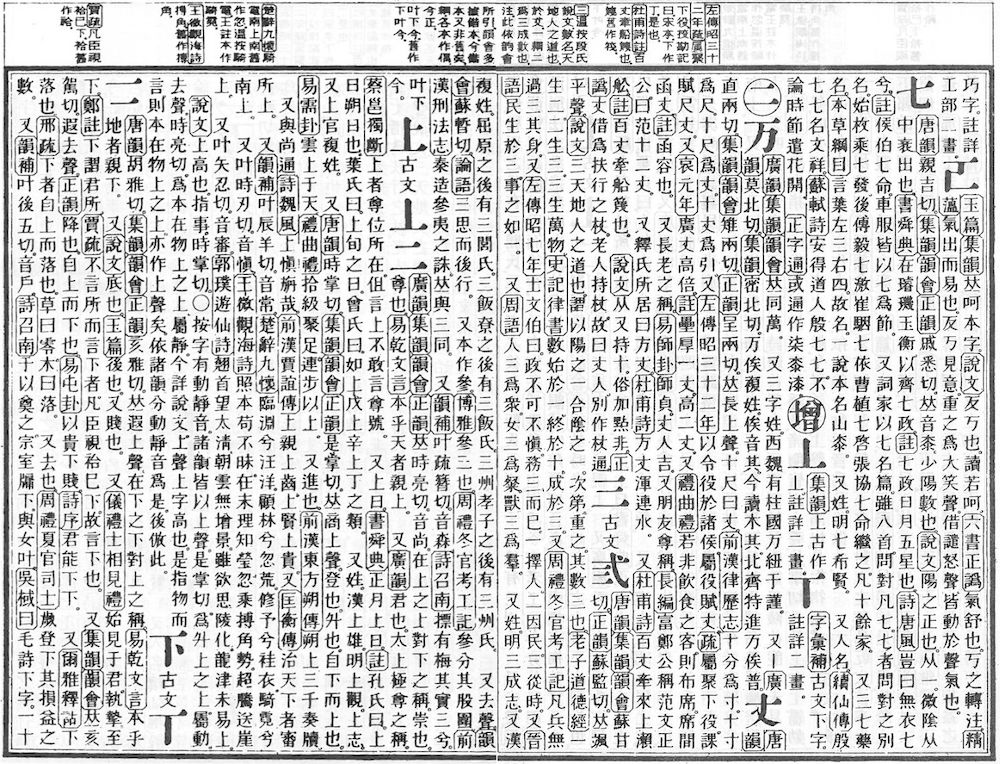 |
Beginning of the Kangxi zidian, reprint (Hong Kong: Huaqiao cidian chubanshe, no year) of the original in the imperial collection of the Wenyuange Studio 文淵閣 (so-called "palace edition" (dianban 殿版 produced with copper plates), but enriched by large seal script characters). |
The Qing-period 清 (1644-1911) compilers made use of older dictionaries, expecially the Ming-period 明 (1368-1644) dictionaries Zihui 字彙 by Mei Yingzuo 梅膺祚 (fl. 1615) and Zhengzitong 正字通 by Zhang Zilie 張自烈 (1597-1673). It consists of 12 "collections" (ji 集) of which each is divided into three parts. It makes use of the 214 radicals system established in the Zhengzitong.
Each character is attributed to a radical. The radicals are arranged according to the number of brush brush strokes. Below the radical levels characters are arranged according to the residual stroke number left after subtracting the radical. The Kangxi zidian contains 47,035 characters in total and was the largest dictionary before the compilation of the Zhonghua da zidian 中華大字典 in 1915. This large number comes into being because all character variants from ancient times on are recorded. For each individual character, the locus classicus is provided.
A long introductory part explains the use of the traditional rhymes (Zimu qieyun yaofa 字母切韻要法). There is also an index for characters whose radical is not easy to determine (Jianzi 檢字) and a chapter comparing characters that are very similar to each other and not easy to discern (Biansi 辨似).
For each character the pronunciation according to the fanqie system 反切 is given first, as it is explained in older dictionaries, like the Guangyun 廣韻, Jiyun 集韻 or Gujin yunhui 古今韻會, and then the direct pronunciation (zhiyin 直音) via a homophonous character.
The pronunciation paragraph is followed by an explanatory part in which quotations from all kinds of literature is given to explain the different meanings of the character, in first place often from the oldest character dictionary of China, the Shuowen jiezi 說文解字, followed by the Confucian classics, historiographic writings, and on to belles-lettres. This part is often followed by a section rendering alternative readings, alternative meanings, and alternative writings of the character.
| 【唐韻】親吉切【集韻】【韻會】【正韻】𠀤(=並)戚悉切,音桼。 | Guangyun reading /tsʰĭĕt/; reading in Jiyun, [Gujin] yunhui, Zhengyun /tsʰiĕt/, pronounced like 桼 /tsʰǐět/ [modern: tʂʰi]. |
| 少陽數也。 | The number of Lesser Yang. |
| 【說文】陽之正也,从一,微陰从中衺出也。【書·舜典】在璿璣玉衡,以齊七政。【註】七政,日月五星也。【詩·唐風】豈曰無衣七兮。【註】侯伯七命,車服皆以七爲節。 | Shuowen [jiezi]: "The correction of Yang. From 'level/the surface of the earth', from which a portion of Yin is protruding." Shang[shu], ch. Yaodian: "[Yao] examined the pearl-adorned turning sphere, with its transverse tube of jade, and reduced to a harmonious system [the movements of] the Seven Directors (transl. Legge 1865)." Commentary: "The seven directors are sun, moon, and the five planets." Shi[jing], ch. Tangfeng: "How can it be said that he is without robes? He has those of the seven orders." Commentary: "The regional rulers and earls dispose of seven [types] of ordinances, for which reason their chariots and robes are [equipped] with the number seven as a tally." |
| 又詞家以七名篇,雖八首,問對凡七。七者,問對之別名,始枚乗七發,後傅毅七激,崔駰七依,曹植七啓,張協七命,繼之凡十餘家。 | Also: The number seven is used as chapter title by poets. Even if [a collection] includes eight poems, there are commonly seven question-and-answer steps. "Seven" is thus a designation for "question and answer", [a custom] begun with Mei Cheng's "Seven openings", and continued with Fu Yi's "Seven incitements", Cui Yin's "Seven consents", Cao Zhi's "Seven beginning", Zhang Xie's "Seven orders", all in all a dozen writers. |
| 又三七,藥名。【本草綱目】言葉左三右四,故名。一說本名山桼。 | Also: "Three-seven" is the name of a medical herb. Bengao gangmu: "The name is derived from [the shape of] their [pinnate] leaves, with three leaflets on the left, and four to the right." One author says, its original name was "mountain sap". |
| 又姓。明七希賢。 | Also: A family name, like Qi Xixian from the Ming period. |
| 又人名。【續仙傳】殷七七,名文祥。【蘇軾詩】安得道人殷七七,不論時節遣花開。 | Also: Personal name. Xuxianzhuan: "Yin Qiqi, [actual] name Wenxiang." Poems of Su Shi: "The immortal Yin Qiqi from Ande was able to cause flowers to open in every season." |
| 【正字通】或通作㭍桼漆柒。 | Zhengzitong: "Also commonly written 㭍, 桼, 漆, or 柒." |
The quality of the entries is very high compared to older dictionaries, as the Kangxi zidian is very critically engaging its sources. There were, nevertheless, errors in the quotations, for which reason Wang Yinzhi 王引之 (1766.1834) compiled a critical appendix to the dictionary, Zidian kaozheng 字典考證, in 12 juan. It contains 2,588 paragraphs of corrected mistakes.
Another critical appendix to the Kangxi zidian was written by the Japanese scholar Watanabe Atsushi 渡部温 (1837-1898), Kangxi zidian kaoyi zhengwu 康熙字典考異正誤, which contains 11,700 entries.
| One Stroke | |||
| 1 | 一 | yi | one; a horizontal stroke |
| 2 | 丨 | gun | a vertical stroke (also read xin or tui) |
| 3 | 丶 | zhu | a dot |
| 4 | 丿 | pie | a stroke curved to the left |
| 5 | 乙 | yi | a bent stroke; the second of the celestial stems |
| 6 | 亅 | jue | a hook |
| Two brush strokes | |||
| 7 | 二 | er | two; two horizontal brush strokes |
| 8 | 亠 | tou | head, above |
| 9 | 人 | ren | man, a person |
| 10 | 儿 | ren | man, a person (at the bottom of a character) |
| 11 | 入 | ru | to enter, to start, to include |
| 12 | 八 | ba | eight; to part, to divide |
| 13 | 冂 | jiong | wilderness |
| 14 | 冖 | mi | cover |
| 15 | 冫 | bing | two dots; ice, cold |
| 16 | 几 | ji | small table |
| 17 | 凵 | qu | widely opened mouth |
| 18 | 刀 | dao | knife, sword, to cut, to separate |
| 19 | 力 | li | strength, force |
| 20 | 勹 | bao | to embrace |
| 21 | 匕 | bi | spoon, ladle |
| 22 | 匚 | fang | square box |
| 23 | 匸 | xi | round box |
| 24 | 十 | shi | ten; two crossed brush strokes |
| 25 | 卜 | bu | to divine, to prognosticate |
| 26 | 卩 | jie | seal, stamp |
| 27 | 厂 | han | cliff |
| 28 | 厶 | si | self, private |
| 29 | 又 | you | to grasp; further, again |
| Three brush strokes | |||
| 30 | 口 | kou | mouth, opening, sounding |
| 31 | 囗 | wei | enclosure |
| 32 | 土 | tu | earth, soil |
| 33 | 士 | shi | official, scholar |
| 34 | 夊 | sui | to walk slowly (at the bottom of a character) |
| 35 | 夊 | zhi | to overtake (at the top of a character) |
| 36 | 夕 | xi | evening |
| 37 | 大 | da | big, large |
| 38 | 女 | nü | woman, female |
| 39 | 子 | zi | child, son; the first of the terrestrial branches |
| 40 | 宀 | mian | roof, cover |
| 41 | 寸 | cun | inch |
| 42 | 小 | xiao | small |
| 43 | 尢 | wang | broken or curved leg |
| 44 | 尸 | shi | corpse, body |
| 45 | 屮 | che | sprout |
| 46 | 山 | shan | mountain, cliff |
| 47 | 巛 | chuan | river, stream |
| 48 | 工 | gong | work |
| 49 | 己 | ji | self, own; the sixth of the celestial stems |
| 50 | 巾 | jin | towel, napkin, cloth |
| 51 | 干 | gan | shield |
| 52 | 幺 | yao | small, young |
| 53 | 广 | yan | house built at a slope |
| 54 | 廴 | yin | to walk a long distance |
| 55 | 廾 | gong | two hands (at bottom of character) |
| 56 | 弋 | yi | to shoot |
| 57 | 弓 | gong | crossbow |
| 58 | 彑 | ji | pig head |
| 59 | 彡 | shan | hair, feather |
| 60 | 彳 | chi | to walk slowly |
| Four brush strokes | |||
| 61 | 心 | xin | heart, feeling, emotions |
| 62 | 戈 | ge | axe, halberd |
| 63 | 戶 | hu | house, door |
| 64 | 手 | shou | hand, actions |
| 65 | 支 | zhi | branch |
| 66 | 攴 | pu | whip |
| 67 | 文 | wen | word, literature; pattern, structure |
| 68 | 斗 | dou | a kind of volume measure |
| 69 | 斤 | jin | a kind of weight measure; axe |
| 70 | 方 | fang | square, direction, locality |
| 71 | 无 | wu | do not, no |
| 72 | 日 | ri | sun, clear |
| 73 | 曰 | yue | to say |
| 74 | 月 | yue | moon, month |
| 75 | 木 | mu | tree, wood |
| 76 | 欠 | qian | to be missing, to be void of, gap |
| 77 | 止 | zhi | to stop, to end |
| 78 | 歹 | dai | evil |
| 79 | 殳 | shu | halberd |
| 80 | 母 | mu | mother (or 毋 wu do not) |
| 81 | 比 | bi | side by side, to compare |
| 82 | 毛 | mao | hair, feather |
| 83 | 氏 | shi | clan, family |
| 84 | 气 | qi | air, breath |
| 85 | 水 | shui | water |
| 86 | 火 | huo | fire |
| 87 | 爪 | zhao | claw, hand |
| 88 | fu | father | |
| 89 | 爻 | yao | to cross two times |
| 90 | 爿 | qiang | bed |
| 91 | 片 | pian | slice, piece |
| 92 | 牙 | ya | teeth |
| 93 | 牛 | niu | cow, ox |
| 94 | 犬 | quan | dog, dog-like animals |
| Five brush strokes | |||
| 95 | 玄 | xuan | black, dark |
| 96 | 玉 | yu | jade, stone |
| 97 | 瓜 | gua | pumpkin, melon |
| 98 | 瓦 | wa | tile, earthenware |
| 99 | 甘 | gan | sweet |
| 100 | 生 | sheng | to give birth, to live |
| 101 | 用 | yong | to use |
| 102 | 田 | tian | field |
| 103 | 疋 | pi | roll, bolt |
| 104 | 疒 | chuang | sick |
| 105 | 癶 | bo | two hands above |
| 106 | 白 | bai | white |
| 107 | 皮 | pi | leather, skin |
| 108 | 皿 | min | plate |
| 109 | 目 | mu | eye |
| 110 | 矛 | mao | spear |
| 111 | 矢 | shi | arrow |
| 112 | 石 | shi | stone, rock |
| 113 | 示 | shi | spirits, ancestor, to pray |
| 114 | 禸 | rou | animal stamping the earth |
| 115 | 禾 | he | ear of grain |
| 116 | 穴 | xue | hollow, hole, hidden |
| 117 | 立 | li | to stand, to erect, to build |
| Six brush strokes | |||
| 118 | 竹 | zhu | bamboo |
| 119 | 米 | mi | rice |
| 120 | 糸 | mi | thread, fabric |
| 121 | 缶 | fou | crock, vessel |
| 122 | 网 | wang | net |
| 123 | 羊 | yang | sheep, goat |
| 124 | 羽 | yu | wings |
| 125 | 老 | lao | old |
| 126 | 而 | er | mustache; but, and |
| 127 | 耒 | lei | handle of a plough |
| 128 | 耳 | er | ear |
| 129 | 聿 | yu | brush |
| 130 | 肉 | rou | meat, organs of the body |
| 131 | 臣 | chen | servant, subject |
| 132 | 自 | zi | nose, self |
| 133 | 至 | zhi | to arrive, to go to |
| 134 | 臼 | jiu | mortar |
| 135 | 舌 | she | tongue |
| 136 | 舛 | chuan | to lye side by side |
| 137 | 舟 | zhou | boat, ship |
| 138 | 艮 | gen | simple, honest, straight |
| 139 | 色 | se | color, outlook |
| 140 | 艸 | cao | grass, herb, plant |
| 141 | 虍 | hu | tiger |
| 142 | 虫 | hui (chong) | insect, creeping animal |
| 143 | 血 | xue (xie) | blood |
| 144 | 行 | xing (hang) | walk, row, line, lane |
| 145 | 衣 | yi | clothing |
| 146 | 襾覀 | ya | cover |
| Seven brush strokes | |||
| 147 | 見 | jian | to see, to observe |
| 148 | 角 | jue | horn; a kind of volume measure |
| 149 | 言 | yan | to speak, words |
| 150 | 谷 | gu | valley |
| 151 | 豆 | dou | bean; a kind of vessel |
| 152 | 豕 | shi | pig |
| 153 | 豸 | zhi | small hairy animals |
| 154 | 貝 | bei | cowry shell |
| 155 | 赤 | chi | red |
| 156 | 走 | zou | to walk |
| 157 | 足 | zu | foot, leg |
| 158 | 身 | shen | body |
| 159 | 車 | che | cart |
| 160 | 辛 | xin | bitter, pepper, sad; the eighth of the celestial stems |
| 161 | 辰 | chen | morning; the fifth of the terrestrial branches |
| 162 | 辵 | chuo | to stamp on the earth, to go, to walk |
| 163 | 邑 | yi | village |
| 164 | 酉 | you | wine, jar; the tenth of the terrestrial branches |
| 165 | 釆 | bian | to distinguish, to separate |
| 166 | 里 | li | mile, hamlet |
| Eight brush strokes | |||
| 167 | 金 | jin | metal, gold |
| 168 | 長 | chang | long, hair |
| 169 | 門 | men | door, gate |
| 170 | 阜 | fu | hill, dam |
| 171 | 隶 | dai | to reach, to catch |
| 172 | 隹 | zhui | small bird |
| 173 | 雨 | yu | rain |
| 174 | 靑 | qing | bluegreen |
| 175 | 非 | fei | wings; not |
| Nine brush strokes | |||
| 176 | 面 | mian | face |
| 177 | 革 | ge | skin, leather, to change |
| 178 | 韋 | wei | tanned leather |
| 179 | 韭 | jiu | chives, scallion |
| 180 | 音 | yin | sound |
| 181 | 頁 | ye | page, face |
| 182 | 風 | feng | wind |
| 183 | 飛 | fei | to fly |
| 184 | 食 | shi | to eat |
| 185 | 首 | shou | head |
| 186 | 香 | xiang | odor, perfume |
| Ten brush strokes | |||
| 187 | 馬 | ma | horse |
| 188 | 骨 | gu | bone |
| 189 | 高 | gao | high, aloft |
| 190 | 髟 | biao | hair |
| 191 | 鬥 | dou | battle, to fight |
| 192 | 鬯 | chang | sacrificial wine |
| 193 | 鬲 | li | a kind of vessel |
| 194 | 鬼 | gui | ghost, spirit, demon |
| Eleven brush strokes | |||
| 195 | 魚 | yu | fish |
| 196 | 鳥 | niao | bird |
| 197 | 鹵 | lu | salt |
| 198 | 鹿 | lu | deer |
| 199 | 麥 | mai | grain |
| 200 | 麻 | ma | hemp |
| Twelve brush strokes | |||
| 201 | 黃 | huang | yellow |
| 202 | 黍 | shu | millet |
| 203 | 黑 | hei | black |
| 204 | 黹 | zhi | needlework |
| Thirteen brush strokes | |||
| 205 | 黽 | min | frog, amphibian |
| 206 | 鼎 | ding | tripod |
| 207 | 鼓 | gu | drum |
| 208 | 鼠 | shu | mouse, rat and similar animals |
| Fourteen brush strokes | |||
| 209 | 鼻 | bi | nose, self |
| 210 | 齊 | qi | equal, all |
| Fifteen brush strokes | |||
| 211 | 齒 | chi | teeth |
| Sixteen brush strokes | |||
| 212 | 龍 | long | dragon |
| 213 | 龜 | gui | turtle, tortoise |
| Seventeen brush strokes | |||
| 214 | 龠 | yue | flute |