ChinaKnowledge.de -
An Encyclopaedia on Chinese History and Literature
Shiming 釋名 "Explaining terms" is a glossary dictionary compiled at the end of the Later Han period 後漢 (25-220) by Kong Xi 孔熙.
With the Confucian concept of retifying names and terms (zhengming 正名), Kong tried to write a dictionary providing the correct designation of all items humans deal with. His dictionary is therefore arranged in an encyclopedical manner, beginning with Heaven and geography, proceeding to human relationships and language, and ending with various objects of all spheres of human activity.
The 27 chapters are arranged in 8 juan. For each character entry the author does not only provide an explanation, but first a kind of memorizing help through a homophonous word which at the same times helps explaining the lexeme word. The whole dictionary is structured according to this concept. This method is called shengxun 聲訓 or yinxun 音訓 "explanation through sound".
| 天,豫司兗冀以舌腹言之。天,顯也,在上高顯也。青徐以舌頭言之。天,垣也,垣然高而遠也。 | "Heaven" (/tʰien˥˩/ 天): in the provinces of Yuzhou, Sizhou, Yanzhou, and Jizhou pronounced with the body of the tongue [because] "Heaven" means "manifest" (/xien˥/ 顯), evidence in the highest place. In the provinces of Qingzhou and Xuzhou pronounced with the tip of the tongue [because] "Heaven" means "circumvallation" (/ĭwɐn˩/? 垣) - high and far-reaching as a wall. |
| 春曰蒼天,陽氣始發,色蒼蒼也。夏曰昊天,其氣布散。皓皓也。秋曰旻天,旻,閔也,物就枯落,可閔傷也。冬曰上天,其氣上騰,與地絕也。 | In spring it is called "blue sky"; when the Yang energy is just about to stir, its colour is blue. In summer, it is called "vast (/ɣɑu˥/? 昊) sky" because [the Yang] energy spreads everywhere and it is whitish (/ɣɑu˥/ 皓). In autumn, it is called "clear (/mĭĕn˩/? 旻) sky" because one mourns (/mĭĕn˥/ 閔) the withering beings. In winter, it is called "high sky" because [the Yang] energy is flying high above, separated from the earth. |
| 故《月令》曰:「天氣上騰,地氣下降。」《易》謂之乾。乾,健也,健行不息也。又謂之玄。玄,懸也,如懸物在上也。 | For this reason the Yueling 月令 "Proceedings in the different months" [chapter of the Liji 禮記 "Records of Rites"] says: "The energies of Heaven are ascended on high, and those of earth have descended beneath." The Yijing 易經 "Book of Changes" calls Heaven /gʰĭɛn˩/ 乾, which means "strong" (/gʰĭɐn˩˥/ 健) or "proceeding without interruption". It is also called "revelation" (/ɣiwen˩/ 玄) or "coming down" (/huen ɣiwen˩˥/ 懸), like objects hanging down from above. |
| 日,實也,光明盛實也。 | "Sun" (/nʑĭĕt/ 日) means "complete" (/dʑʰĭĕt/ 實); its rays are rich and full. |
| 月,缺也,滿則缺也。 | "Moon" (/ŋĭwɐt/ 月) means "gap" (/kʰĭwɛt/ 缺); if [the moon] is full, it [starts] to decrease. |
| 光,晃也,晃晃然也。亦言廣也,所照廣遠也。 | "Bright" (/kuɑŋ˥˩/ 光) means "dazzling" (/ɣuɑŋ˥/ 晃) - glaring. Also means "wide" (/kuɑŋ˥/ 廣); [sunrays] are ranging far and wide. |
Although this method today seems to be simply a memorizing help during the Han period, when cosmological speculations were a common philosophical field, the homophonous similarities were also of a semantic significance.
The Shiming is not only an important source for the treasury of words of Han-period everyday language, but also for the study of ancient Chinese phonology. It belongs to a series of early glossaries of synonyms based on the Classic Erya 爾雅, namely Xiao erya 小爾雅, Guangya 廣雅, and Piya 埤雅. These are called the "Five [books] of correct [expressions]" (wuya 五雅), while the book Shiya, deviating in its arrangements of lemmata, is also called the "remnant [book] of correct [expressions]" (Yiya 逸雅).
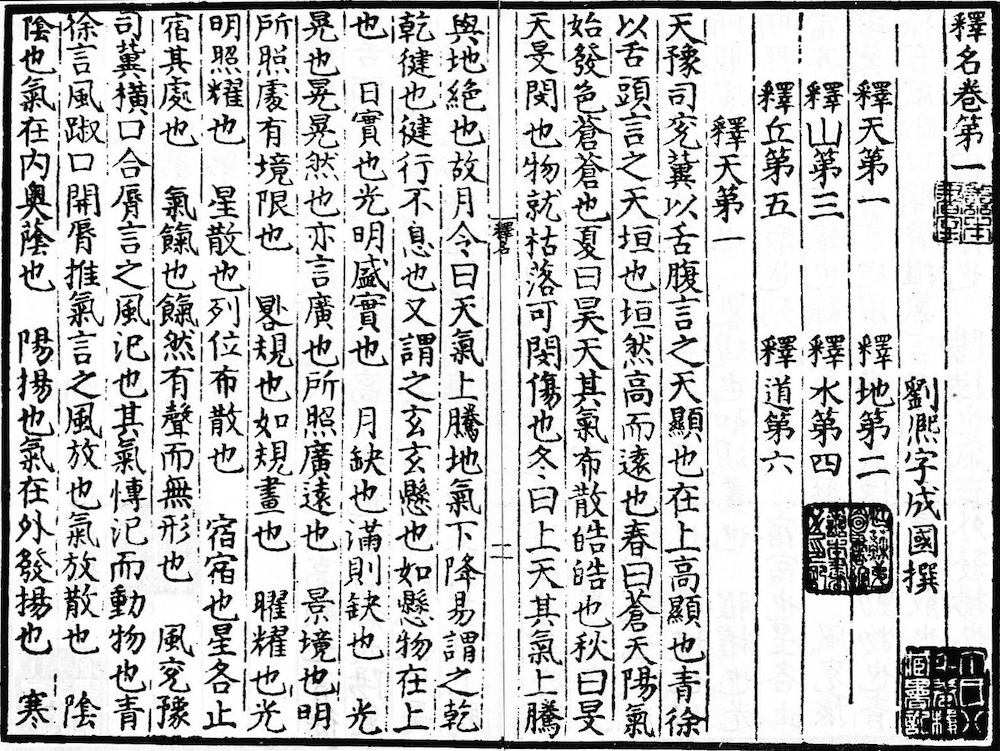 |
Beginning of the Shiming, Sibu congkan 四部叢刊 edition, reproducing a Ming period (Jiajing reign-period) reprint of a Song period print; from the collection of the Jiangnan Library 江南圖書館 in Nanjing 南京, Jiangsu. |
There is a surviving Ming-period 明 (1368-1644) reprint of an early edition of the Song period 宋 (960-1279) which contains a lot of errors. The Qing-period 清 (1644-1911) scholar Bi Yuan 畢沅 (1730-1797) wrote a critical commentary, Shiming shuzheng 釋名疏證, in which he rectifies these errors. An additional work was written by Wang Xianqian 王先謙 (1842-1918), Shiming shuzheng bu 釋名疏證補.
Bi Yuan also wrote to supplements, one called Xu shiming 續釋名, and one Shiming buyi 釋名補遺. Both are attached as appendixes to the commentary Shiming shuzheng bu. The former consists of additional lemmata concerning music and intontation (Shi lülü 釋律呂, Shi wusheng 釋五聲). The latter is a collection of 31 fragments.
| 1. | 釋天 | Heaven |
| 2. | 釋地 | Earth |
| 3. | 釋山 | Mountains |
| 4. | 釋水 | Rivers |
| 5. | 釋丘 | Hills |
| 6. | 釋道 | Regions |
| 7. | 釋州國 | Provinces |
| 8. | 釋形體 | The human body |
| 9. | 釋姿容 | Females |
| 10. | 釋長幼 | Age and infanticy |
| 11. | 釋親屬 | Kinship |
| 12. | 釋言語 | Language |
| 13. | 釋飲食 | Drinking and food |
| 14. | 釋綵帛 | Material and textiles |
| 15. | 釋首飾 | Head adornments |
| 16. | 釋衣服 | Clothing |
| 17. | 釋宮室 | Palaces and buildings |
| 18. | 釋床帳 | Beds and covers |
| 19. | 釋書契 | Books and writing |
| 20. | 釋典藝 | Canons and classics |
| 21. | 釋用器 | Utensils |
| 22. | 釋樂器 | Musical instruments |
| 23. | 釋兵 | Military |
| 24. | 釋車 | Carts |
| 25. | 釋船 | Boats |
| 26. | 釋疾病 | Diseases |
| 27. | 釋喪制 | Funeral |
The Guang shiming 廣釋名 "Extended Shiming" is a glossary from the Qing period 清 (1644-1911) written by Zhang Jinwu 張金吾 (1787-1829), courtesy name Shenzhan 慎旃 or Yuexiao 月霄, as a supplement to the Han-period 漢 (206 BCE-220 CE) glossary Shiming 釋名.
The supplement of 2-juan length was completed in 1814. Zhang collected words and terms from the Han period not included in the Shiming and arranged them in the same way and constructed with the same method as the Shiming. The dictionary is divided into encyclopaedic fields of nature and human acitivites. For each character, a homophonous word is given which, in a unitary cosmological sense, serves as an explanation of the lexeme.
The Guang shiming is included in the series Zhibuzuzhai congshu 知不足齋叢書.