ChinaKnowledge.de -
An Encyclopaedia on Chinese History, Literature and Art
The Mohe 靺鞨, Korean reading Malgal, were a people living in the northeast of China during the Sui 隋 (581-618) and Tang 唐 (618-907) periods. Chinese historians identify them with the people of the Sushen 肅慎 that lived in this region during the Former Han period 前漢 (206 BCE-8 CE), and the Yilou 挹婁 that lived there during the Later Han 後漢 (25-220 CE) and the Jin 晉 (265-420) periods. From the 5th to the 6th century they were called Wuji 勿吉 or Woju 沃沮, which seems to be a different phonetic rendering of their name. It seems that the ethnic identity of the people was the same, although the names changed over time.
The word Sushen was also written Xishen 息慎 of Jishen 稷慎. According to ancient writings they lived north of the Buxian Range since the times of the mythological emperors Yao 堯 and Shun 舜, and delivered tributes to the court of the Zhou dynasty 周 (11th cent.-221 BCE), especially bows and arrows. In recent times archaeological findings in that region from the 1st millennium BCE were attributed to the so-called Xituanshan Culture 西團山文化. The people from this culture made use of polished stone tools and pottery, but only scarcely used bronze vessels, as it was common in the states of China proper. It can be assumed that the people of the Sushen and Yilou belonged to the Tungus branch of the Altai peoples.
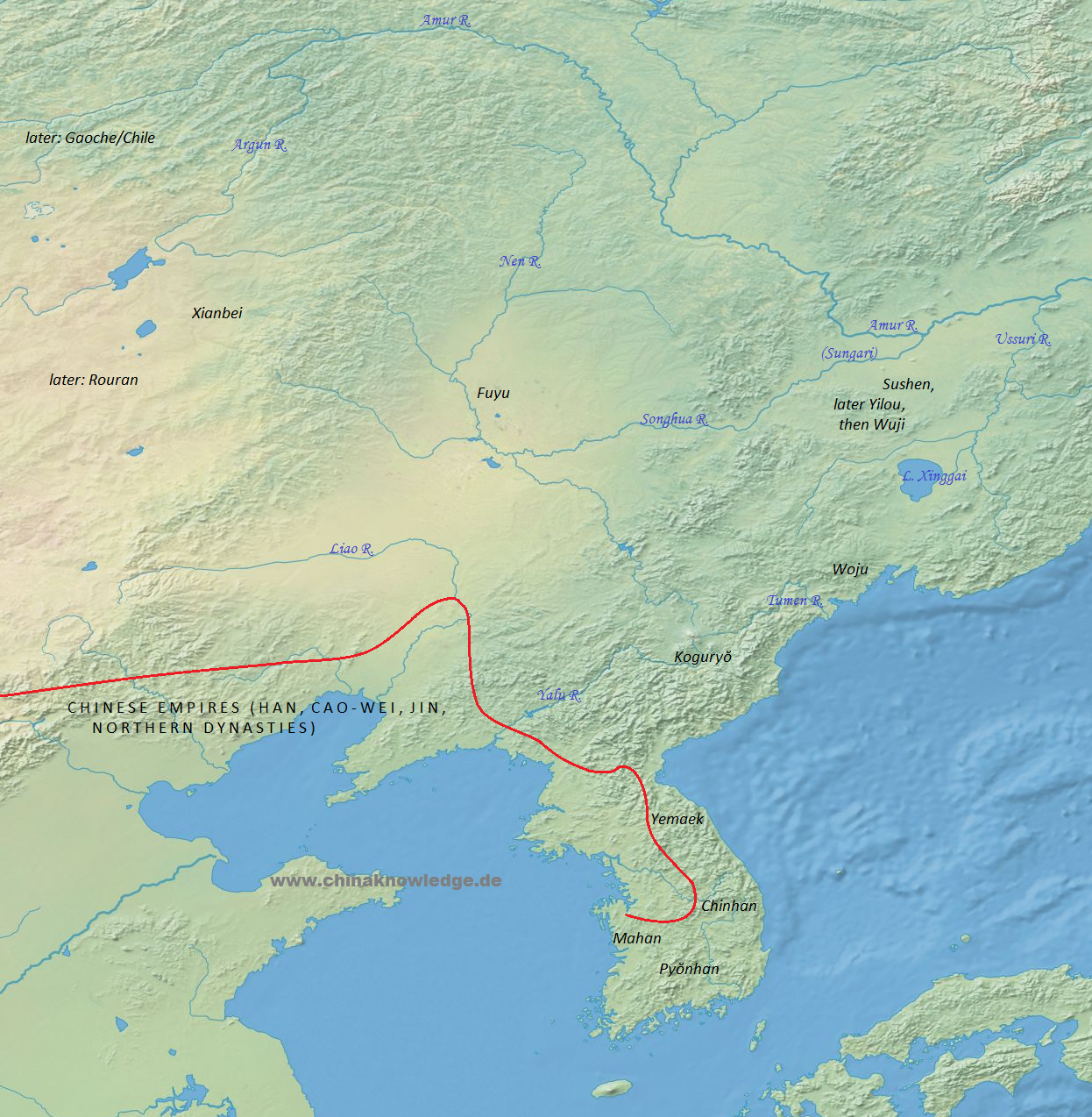 |
Northeast China and its surroundings c. 200 BCE-500 CE. Based on Tan Qixiang 譚其驤, ed. (1995), Zhongguo lishi ditu ji 中國歷史地圖集, Vol. 2-4 (Beijing: Zhongguo ditu chubanshe, 1996). Border very approximative. |
The Wuji lived in the region of the rivers Amur 黑龍江, Songhua 松花江 and Ussuri 烏蘇里江, north of the Changbai Range 長白山, and east to the shore of the Japan Sea. They delivered tributes to the court of the Northern Wei dynasty 北魏 (386-534). In 493 they destroyed the ancient state of Fuyu 夫余 that was located south of their territory, in modern North Korea. The Wuji were a strong federation of several dozens of tribes, the most important of which were the Sumo 粟末, Boduo 伯咄, Anchegu 安車骨, Funie 弗涅 Haoshi 號室, Heishui 黑水 and Baishan 白山 tribes. Their chieftains were called da mofumanduo 大莫弗瞞咄.
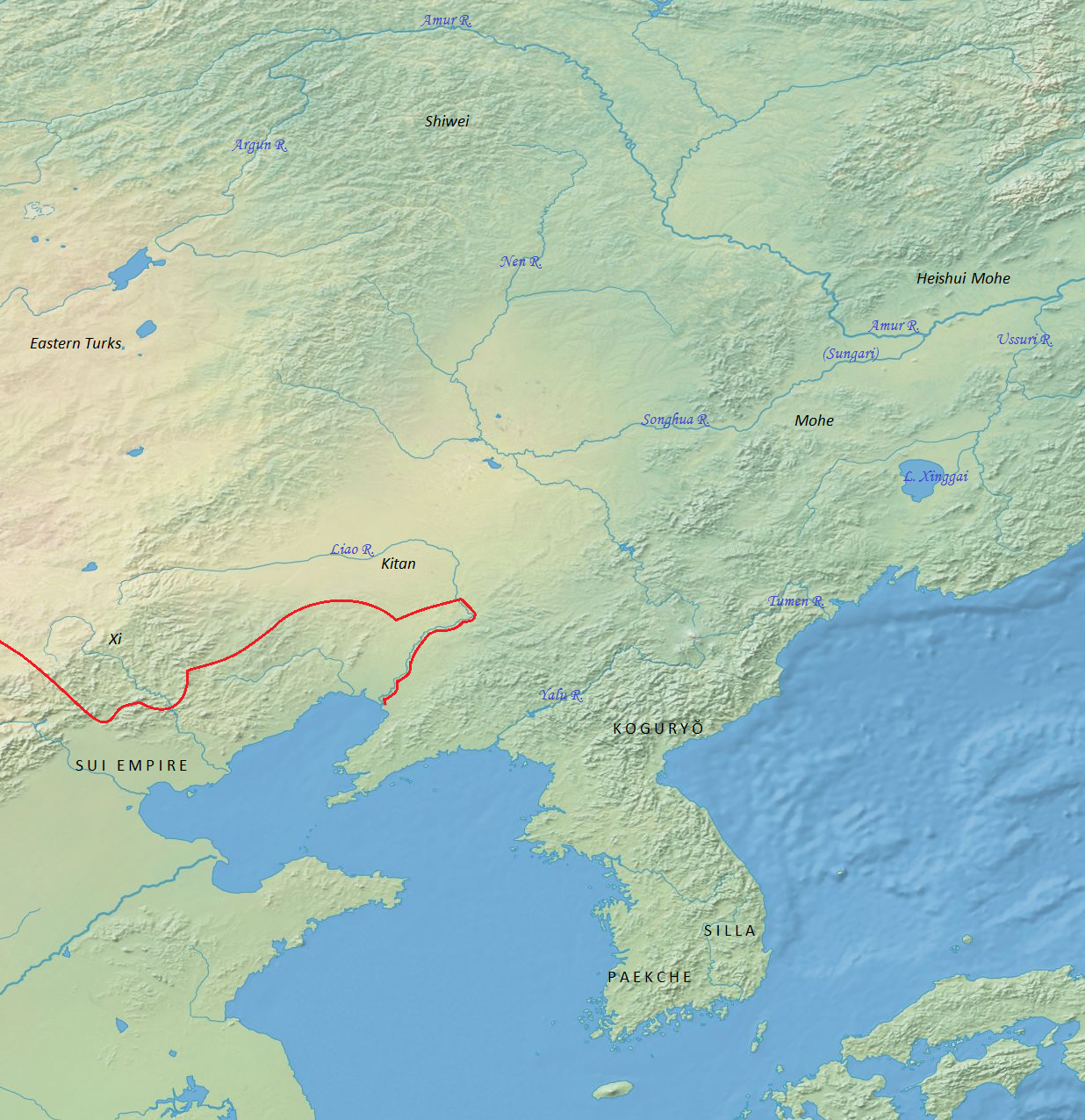 |
Northeast China and its surroundings c. 600 CE. Based on Tan Qixiang 譚其驤, ed. (1995), Zhongguo lishi ditu ji 中國歷史地圖集, Vol. 5, Sui Tang Wudai Shiguo shiqi 隋唐五代十國時期 (Beijing: Zhongguo ditu chubanshe, 1996). |
From the late 6th century on Chinese sources called them Mohe. The Mohe were agriculturalists and were famous for their pig breeding. From time to time they also undertook hunts. They lived in earth huts, women used to wear skirts, and men leather clothes of pig or dog skin. The southermost tribe were the Mohe of Sumo that had often conflicts with their southern neighbours, the kingdom of Koguryŏ 高句麗. Emperor Yang of the Sui dynasty 隋煬帝 (r. 604-617) ordered their chieftain Tudiji 突地稽 to settle his people down in Yingzhou 營州 (modern Chaoyang 朝陽, Liaoning). The northernmost tribe of the Mohe were the "Black Water" Heishui.
In 722 the Tang court reveiced a visit of their chieftain Nishuliji 倪屬利稽. Emperor Xuanzong 唐玄宗 (r. 712-755) appointed their chieftain regional inspector (cishi 刺史) of Boli 勃利. In the late Tang period the area command (dudufu 都督府) of Heishui was inaugurated, and the chieftain of the Heishui Mohe was appointed commander-in-chief (dudu 都督). The other tribes were administered in this dudufu, and their chieftains appointed zhou cishi 州刺史. A commissioner dispatched by the Tang court supervised them. In 728 the dudu was granted the imperial surname Li 李 and was made regulatory commissioner (jinglüeshi 經略使) of Heishui, and concurrently dudu of the prefecture of Youzhou 幽州 (modern Beijing).
From the late 8th century on the Mohe came under the domination of the kingdom of Bohai 渤海.