ChinaKnowledge.de -
An Encyclopaedia on Chinese History, Literature and Art
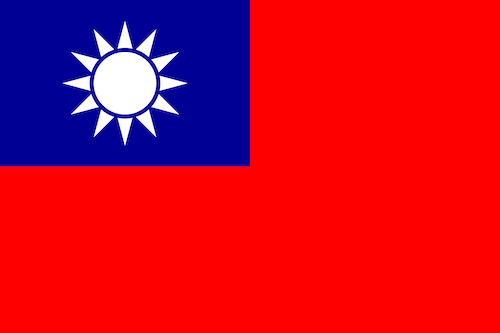
The Republic of China (Zhonghua minguo 中華民國, ROC), founded in 1912, a the rightful state exerting sovereignty over the island of Taiwan and several smaller islands in the Taiwan Strait and at the coast of the People's Republic of China. The ROC is the heir of the Republic of China (1912-1949) and one of its constitutional bodies, the National Assembly (Guomin Dahui 國民大會), therefore included until 2000 representatives of the mainland provinces.
When Chiang Kai-shek 蔣介石 (Jiang Jieshi, 1887-1975) and his Nationalist Party Kuomintang (Guomindang 國民黨, KMT) fled mainland China in face of the conquest by the Communist Party (Gongchandang 共產黨), they expected a reconquest of the mainland in the near future. Yet facts showed that such a war would not be possible, and there were only minor clashes in the late 1950s on some islands located before the coast of mainland China and belonging to the territory of Taiwan.
In 1971, the Republic of China lost its seat in the United Nations and its Security Council. These seats fell to the People's Republic of China. As a consequence, most states today do not acknowledge Taiwan as an independent country, but only have para-diplomatic relations with the Taiwanese government in the shape of economic bureaus.
Basing on the economic infrastructure established during the Japanese colonization (1895-1945), the ruling Kuomintang and its one-party state made Taiwan one of the so-called Tiger States (the others being South Korea, Singapore and Malaysia). Chiang Kai-shek's son Chiang Ching-kuo 蔣經國 (Jiang Jingguo, 1910-1988, President 1978-1988) initiated a series of democratic reforms on the local level. The first free elections for office of president were held in 1996, and won by Lee Teng-hui (Li Denghui 李登輝, 1923-2020, President 1988-2000). The most important competitor of the Kuomintang was the new Democratic Progressive Party DPP (Minjindang 民進黨). In 2000, Lee Teng-hui was succeeded by the first president who was not a member of the Kuomintang, namely Chen Shui-bian 陳水扁 (Chen Shuibian, b. 1950, President 2000-2008). Chen's victory was a sign that Taiwan had reached the status of a fully developed democracy. Chen tended to envisage the independency of Taiwan as an individual state and thus deviated from the one-China principle held upright by the Kuomintang as well as the People's Republic of China. The latter decided to promulgate an anti-secession law that allows the use of military force to punish parts of "China" proclaiming independence. Chen Shui-bian amended the constitution and abolished the National Assembly that still included representatives of the mainland China provinces.
Corruption among the presidential family was one of the reasons for the DPP's failure in the presidential elections in 2008, when Ma Ying-jeou 馬英九 (Ma Yingjiu, b. 1950, President 2000-2016), the candidate of the KMT, won the office of president and began a policy of concession with the People's Republic that led to intensive economic cooperation across the Taiwan Strait, with huge investments of Taiwanese enterprises on the mainland. This conciliatory policy, leading to increasing economic dependency from Communist China, was ended with the elective victory of Ms Tsai Ying-wen 蔡英文 (Cai Yingwen, b. 1956, President since 2016) of the DPP in 2016. Popular protest against the KMT-induced dependency from Communist China was expressed in the Sunflower Movement 2014. Tsai Ying-wen's presidency falls into a phase of increasing authoritarianism and aggressive foreign policy under Communist President Xi Jinping 習近平 (President of the PRC, since 2012). The latter's alliance with the President of Russia, war criminal Vladimir V. Putin, and various other highly authoritarian regimes across Asia, stokes fears, after explicit announcements of Xi, that the Communists will follow Putin, who tried to invade democratic Ukraine, and take steps to wipe out and "reintegrate" Taiwan by military force.